All posts by Tony Henrie

WTR site owner.

A Three-Day Pack Trip On the Paunsaugunt Plateau

I’m finally getting around to writing up my solo horse pack trip from  October, 2020, down around the southwest end of the Paunsaugunt Plateau in central Utah. It’s been awhile, but I always keep a hand-written journal, so I will refer to it to refresh my memory. I’m sorry to say, however, that since it was a solo pack trip, there aren’t as many photos as I would have liked and none of myself. Still, it was a refreshing and enjoyable trip, which was the whole purpose of the thing in the first place.

I had high ambitions for this trip, at least in the planning. My intention was to drive down to the Losee Canyon Trailhead, near Bryce Canyon National Park, Utah on Monday, October 19, set up a camp, and ride the Thunder Mountain Trail that afternoon. That trail is a fairly short out-and-back, so I would return to camp that evening. The following day, I would pack up the horses and head out for a 2-day pack trip, starting on the Grandview Trail #66, southward to Badger Canyon, then eastward up to Tropic Reservoir, returning northward across the top of Paunsaugunt Plateau to the top of Casto Canyon, thence descending Casto Canyon and returning to my point of beginning on Wednesday evening. I calculated it would make about a 50-mile trip. Then, on Thursday, I was to drive across the plateau to Canonville, where I would stop and ride Willis Creek, before heading on down to set up a camp near the trailhead for Buckskin Gulch, just south of US89, between Page, AZ and Kanab, UT. I would ride the Gulch, about a 20-mile ride, on Friday. Then, on Saturday, I would spend a little time doing some scouting between the Gulch and the North Rim of the Grand Canyon along the Arizona Trail, in preparation for my crossing of the Big Ditch next spring. I was seriously looking forward to this trip!

Things started to unravel several weeks before the trip even took place, when my 2005 Dodge 3500, sporting over 350,000 miles, began to have problems. I had taken a weekend trail ride trip with Jon Tanner and friends up to Red Castle in northeastern Utah a few weekends before. The last several miles before reaching our camp area was on a very rough washboard dirt road that nearly rattled my pickup apart! After that, several things failed.  The “Check Engine” light came on, my air conditioner stopped working, and my alternator became intermittent. Then, the weekend before this pack trip, coming home from a ride out in Skull Valley, Utah, a fitting on a power steering line came loose and leaked out all my power steering fluid.  With some help from a good Samaritan in Eureka, Utah, (where there is no auto parts store and no cell signal at all) I was able to repair it well enough to limp on home.  Once I repaired the power steering system, there was obviously an electrical problem somewhere in the system still to deal with. I connected my code reader to the OBDII port on the pickup and was surprised to find it would not connect.

I replaced the alternator and just disregarded the A/C, since winter was coming on anyway, and thought I had fixed things.  I headed over to the Dodge dealership to see if they might be able to re-program the pickup and solve the “Check Engine” issues. Their advice was, that since it was running, not to attempt to re-program it, because, in order to do so they would have to “wipe” the truck computer, then re-install the programming. My year of truck was known to have a glitch in which it sometimes would not accept the re-programming, which would necessitate the purchase of a new computer…which are in short supply and very expensive. I decided to just let it go.

So, I went home and started tracing out my electrical harness and trying to locate anything that might be an electrical short. I located a pair of shredded wires that connected to the A/C compressor. Eureka! I thought. I repaired the two wires, hoping that would solve all my troubles. It did not. Still, the pickup was running well, just a little under-powered.  So I decided to continue with my plans.

On Monday morning, October 19, I went to the car wash and used the engine de-greaser to clean off as much of the power steering fluid as possible, from under the engine compartment of the truck, so I could make sure the power steering leak issue was fixed. It seemed to be ok. However, I then discovered that one of the duals on the rear of the truck had picked up a drywall screw and had a slow leak. So, I spent the rest of the morning at Big-O tires in Spanish Fork, getting that repaired.

Finally, about 3:30 in the afternoon, I was packed up and headed south. By the time I was halfway to Panguitch, Utah, I knew something was still very wrong. On some of the uphill pulls my truck just felt weak and I was having 18-wheelers passing me! My fuel mileage was also way down.  Not only that, but during the drive I suddenly remembered that I had forgotten to grab my riding boots and toss them into the trailer! And here I was with only my low-top tennis shoes! Could anything else go wrong?  I finally made it to my selected camp area, near the Losee Canyon Trailhead, just in time to set up camp before dark.

I determined that I would go to Panguitch the next morning and see if I could buy a pair of boots and look for a particular sensor for the pickup that seemed to be at the root of the engine problems.

Due to the delays and other issues, it was pretty clear I was going to have to make adjustments to my plans for the trip. I had conversed briefly about things with Jon Tanner, who I think knows every trail in Utah, about my trip. He suggested that my 50-mile pack trip might take longer than the two days I had planned and that I might consider alternate routes or adding a day to it. He also mentioned that the Grandview #66 trail was the same trail that started the Thunder Mountain Trail, so I decided that I would just take the Thunder Mountain trail, which is an out-and-back that takes off from the GV#66, as I started out on my pack trip. That would save a day. I also decided to allow a third day for the pack trip, which would mean I would have to eliminate the scouting trip on the Arizona Trail.

So, with all that settled in my mind, I went to bed.

Tuesday morning, I arose, made myself a nice breakfast, then headed in to Panguitch. I have fond childhood memories of Panguitch, since it is a prominent part of my heritage. Panguitch was settled in the late 1800s and my ancestors were among the first to settle there. In fact, the first large home built outside the old fort, according to family history, was built by Samuel Henrie for his large family. That home still stands…although there is disagreement as to which home it really was.  My father was born and raised in Panguitch and my family often visited there on vacations when I was young. I have very fond memories of my grandmother, Nina Hatch, and great-grandmother, Mary Houston, who were permanent fixtures and part of the history of Panguitch. I have cousins who still live in Panguitch.

Anyway, back to the point at hand – I went directly to the local western clothing store to buy boots…only to discover they do not sell boots! They advised me to check the local Ace Hardware. I was very happy to find the Ace Hardware, being the only store in town that sells boots, had a pair of Georgia Boot Wellingtons in my size! Not what I was hoping for, but would do the trick, so, out the door I went with them. I then headed for the local NAPA Auto Parts store. They did not have the part I needed in stock, but could have it the following day. Instead, I bought a can of brake cleaner and decided just to try to clean the sensor and see if that would fix it.

So, armed with new boots and a can of brake cleaner, I headed back to camp. After cleaning the sensor and re-installing it, and starting the truck just to make sure, I was satisfied that at least things were no worse. So, I decided to continue with my trip.

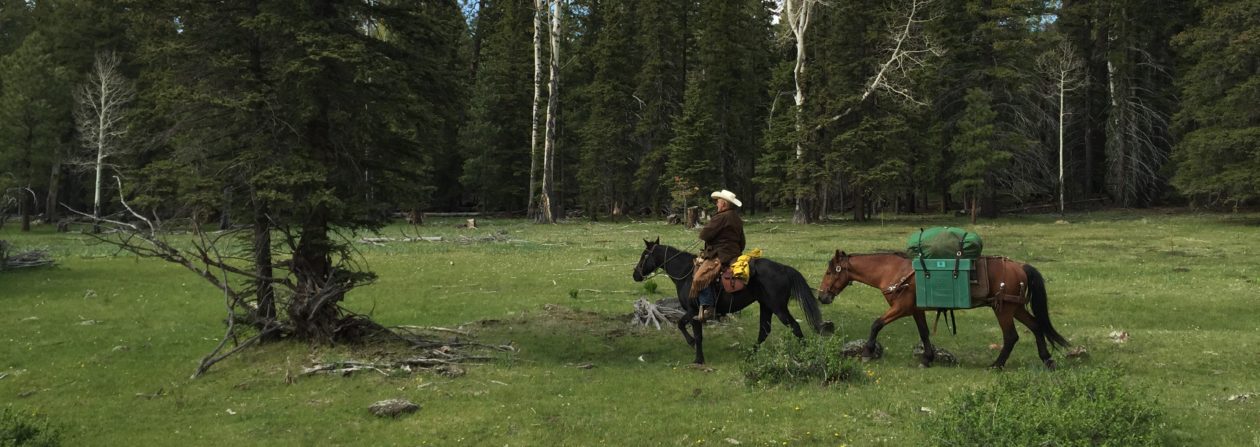
I got all packed up and on the trail by about 1:30pm. On this first day, I decided to ride Copper and pack Chief. I had Chief loaded with light packs, being probably 150 pounds total. I don’t need much when I pack solo. I decided to use the soft panniers on this trip, since I wasn’t taking enough gear to fill my hard panniers. Copper, on the other hand, had quite a load: Me, my 40-pound saddle, saddle bags, pommel bags, canteen, etc., totaling probably 270 pounds or more. I would be switching off between the two horses, so I wasn’t too worried about overloading either one.

We had about a two-mile ride back to State Route 12, crossed it, and made our way to the trailhead. Now, outside the park boundaries is BLM land, so dispersed primitive camping is allowed pretty much anywhere outside of the highway easements. The Grandview/Thunder Mountain trailhead has a very nice paved parking area that can accommodate several horse trailer rigs, but there is no overnight camping there. It is located on Route 12, about two miles east of US89, just as the road starts up into the canyon.

We passed through the parking area, stopped to take a look at the signs and information board, then headed out. Just a note about the trail sign: The Thunder Mountain Trail # .098, is a trailhead for pedestrian and bicycles. I don’t believe equines are allowed on that trail. Most of the hikers and bikers seem to start on that trailhead and either do and out-and-back or complete the loop, returning by way of the Grand View #66, because that route is generally a downhill trail. That trailhead is located a little ways farther up the road. For equestrians, taking the Grand View Trail #66 will get you to the Thunder Mountain trail within a mile or so, where you turn off and do an out-and-back.

We encountered several small groups of bikers on the trail, which is something to keep in mind, as some bikers have absolutely no understanding of what to do with a horse encounter and many of them come literally blasting down the trails on their nearly silent bicycles! Thankfully, the several bikers we encountered were very courteous and careful and my horses are very accustomed to foot and bicycle traffic and we had no problems. We also encountered several hikers and backpackers. This was Copper’s first time to encounter a backpacker with a large pack and he stepped very lightly around the first one. After that all was well.

The landscape and topography was stunning in those first few miles – red cliffs and green cedars/junipers. It got even better as we climbed and the views became longer. Both horses were excited to be on the trail and moved out at a good pace.

I decided to forego the Thunder Mountain Trail and just continued on the GV#66, due to our late start. I’m glad I made that choice, because things worked out pretty tight, time-wise.

After several miles, both horses started slowing down a little and settling into a solid walk. I had to stop a couple times to re-settle my top pack, which had my sleeping bag and some clothing items in it. It kept sliding off to one side, even though I had everything cinched down under a diamond hitch, so I had to do a better job of securing it.

I found there is water sufficient for the horses at various places. The first water we encountered, however, was in a creek about 7 miles in. There is a nearby ranch there as well, and a ranch road that heads westward to US89. After that, we came upon water about every two miles or so, in creek beds and water troughs. Grass is sparse, however and not sufficient for grazing until we got up near Tropic Reservoir.

At about the 8-mile mark, we came into a valley that had a marshy bottom. By this time, Copper was accustomed to following a trail, so I let him walk and spent a lot of time looking around at the beautiful country and dreaming my dreams. Suddenly I realized we weren’t on the designated trail! This area gets little foot traffic, since most hikers, bikers, and equestrians turn off onto the Thunder Mountain Trail, which we had passed several miles back. This bottom was criss-crossed with cow and game trails that evidenced more traffic than the designated trail!

Still unsure, we continued on, hoping to come upon some marker that would indicate were were back on the real trail, but things quickly became difficult. The growth became thicker, blowdowns were becoming a problem, and we were wandering around just trying to make our way through the valley, hoping to find the trail on the hillside on the opposite side.

As we made our way through the thicket, I turned Copper toward an open area that appeared to have a little stream of water passing through it. I figured it would be a good chance to give the horses a drink, since water is quite sparse on this trail. I stepped Copper over a fallen log and into the open area. As he stepped over the log, he immediately sunk nearly up to his belly! It was a bog! I let go of Chief’s lead, hoping he would stop and not enter the mud, while Copper struggled to get to solid ground. It was useless. Copper sunk up to his belly and quickly became mired. While he rested in the mud, I dismounted and began removing my gear. Solid ground was only about 10 feet away, so I carried all the gear there and dropped it, returning to Copper to remove the saddle. By this time, both Copper and I were pretty well covered in mud. I was beginning to appreciate the new boots I had bought, finding that they were waterproof, so at least my socks were still dry.

After getting Copper unsaddled and letting him rest a few minutes, I was able to help him get unstuck and he struggled to the solid ground.  In the meantime, I had brought Chief around the bog and tied him, where he waited patiently. I wiped off as much mud as I could from Copper and re-saddled him and loaded my gear up. I decided that I would tie both horses and scout around on foot, to see if I could re-locate the designated trail, before mounting up again.

I led both horses into an area that was a little clearer, out of the thicket, and tied both to perfectly good aspen saplings with a little grass around them, then I headed off into the woods with my handheld GPS to find the trail. I hadn’t gone more than about 100 feet, when Chief started acting up. I watched him begin to circle around the tree, then stamp his feet, then he started kicking and jumping around. Since that is not like Chief, who is as calm as a summer evening, a thought quickly flashed into my mind: Wasps!

I ran to Chief and quickly pulled loose the safety knot to release him. He continued to pound around me, trying desperately to escape the stinging yellow-jackets while not trampling me! I headed off through the trees, leading him as quickly as I could, until I thought we were far enough away. I tied him to a tree and returned to get Copper, just as the yellow-jackets began their attack on him. I pulled his knot loose and quickly led him to where Chief was waiting. The yellow-jackets followed us!

I then grabbed both lead ropes and ran through the trees, with both horses following closely. We went nearly 50 yards before I was sure the wasps had stopped following. I then stopped and began swatting several wasps that were still hanging on and stinging the horses, until I got them all and the horses began to calm down. In the process, I was stung several times as well. Once we were all getting our wits back about us, I mounted and headed back along the trail that got us into the mess. I was quite proud that my horses handled the wasp attack as well as they did. It could have been a lot worse!

It wasn’t long before we came upon the designated trail, as confirmed by my GPS unit, and discovered that the designated trail had taken a turn, while a cattle trail had continued straight on into the valley, which is why Copper had missed the turn. Once back on the trail, I soon found a marker that confirmed we were, indeed, on the right trail.

The above setback, delayed us more than a half-hour, so I was beginning to be concerned that we wouldn’t make our planned camp area before dark. The area we were crossing had few areas that would make decent camps with horses, there being no water or grass and few level areas.

After a climb of another mile or so, we came upon a Forest Service “guzzler” that had water in it. We could have stopped at this place for the night, but we still had a bit of daylight left and I wanted to make it to Proctor Canyon, which was about another mile. I decided to keep going.

Past this point, the trail became pretty steep and quite sketchy in a couple areas. Nothing that was a problem for my horses, but for a horse not accustomed to rough mountain trails or for a rider not accustomed to riding on such trails, some of these passages would be quite intimidating, as we descended into some pretty steep canyon trails.

We finally descended into Proctor Canyon just as darkness settled upon us. I found a level area in a sage flat in the bottom of the canyon, near where an ATV trail crossed the GV#66. We made a dry camp there. There is a creek in the very bottom of the canyon, but it was in the bottom of a steep gulley about 30 feet deep and only about twice that wide. We camped above the creek on the flat. We had made 12.8 miles that afternoon.

I settled both horses, letting Copper graze on the sparse grass, while I unpacked Chief, then vice-versa, while I unpacked Copper. I tied Copper and left Chief grazing for awhile, before I tied them both and fed them from a sack of alfalfa pellets I had brought along for that purpose. Turned out Chief didn’t like the pelletized feed, so I put his hobbles on and let him loose for the night, while keeping Copper tied.

After laying out my sleeping bag, I prepared a quick dinner from a pre-packaged dehydrated meal, caught up my journal for the day, and went to bed. One thought I had, before I laid down my head: Why in the world did I decide to bring the soft panniers instead of the hard panniers! It would have been nice to have something to sit on at camp, while I took off and put on my boots! Also, hanging the hard panniers on the pack saddle and strapping it into place is so much easier than tying up a diamond hitch! Still, I have always been a traditionalist and love the old ways of doing things.

The following day, Wednesday, I arose to a very cold morning. I hadn’t slept very well. I had made the mistake of tying Copper too close to my bed site and he made a lot of noise all night long, because Chief was loose and he was not. I eventually got up and tied Chief as well, hoping Copper would settle down. I felt pretty good, though, so I must have slept more than I thought.

I made myself a breakfast of instant oatmeal and half a bagel, noting that while the water in my canteens did not freeze, the water in the bottom of my cup did! So, the temperature must have been hovering right around freezing. After the horses fed awhile, I loaded them up and we got started. I suppose it was around 9:00am when we headed out.

I had decided to try to get some video footage with my GoPro Silver camera, so I mounted it on the chest mount harness and donned my coat over it. In the process, I had removed the sheepskin vest I was wearing, so as to wear it over the harness. Somehow, I had laid the vest aside and forgot all about it and left it there at the camp. The worst of it was that all my video footage came out very poorly. Between the motion of my body and the motion of the horse, one could almost get motion sickness watching it. I plan to try to save some of it with software stabilization, but I’m not very hopeful.

Anyway, off we went, having to cross that deep gulley in the bottom of Proctor Canyon right off. I was riding Chief this morning, and he was feeling reluctant and a bit ornery, as youngsters sometimes do. I rode him around a little, leading Copper, to get Chief settled a little bit before starting down that steep and difficult descent into the gulley.  After a few minutes I felt I could trust him and we descended the trail.

At the bottom of the gulley, I let both horses drink in the creek. While doing so, Chief acted up a little and I lost Copper’s lead rope. While I got Chief under control, Copper decided to head for home! My salvation was that he headed downstream in the bottom of the gulley, rather than back up the trail. I dismounted and tied Chief and headed after Copper on foot, since I knew that if I followed him on Chief, he would see that Chief was following and would not stop. As it was, I followed Copper about 100 yards, before he stopped at a particularly narrow place in the bottom and I was able to catch him.

With that little reminder about Copper, I should have been a little more careful with him, but, as you will see, my complacence came back to bite me later on.

The trail up out of Proctor Canyon follows a steep sidehill, but is a pretty decent trail, mostly used by cattle, ranchers, and hunters, and a few hikers. We made good time heading up the trail. The canyon forks and the GV#66 follows up the southern branch, while the ATV trail goes up the main canyon. We continued on the GV. At the top of the canyon there is a nice flat open area with a small pond and water tank.

The horses were not thirsty, so after a short breather, we continued on, departing GV#66 and heading eastward toward Badger Canyon on ATV trails. After a pretty tough climb, we joined the designated ATV trail (FRV233) and continued on, following Skunk Creek down toward the East Fork of the Sevier River.

About 12:30pm, we stopped in a nice open meadow and took a lunch break. I unloaded both horses put on their hobbles and let them graze. After the climb out of Proctor Canyon, they needed the rest. They stayed close by and exhibited no tendency to wander.  They didn’t seem to like the grass too much, but they nibbled at it while I ate my lunch.  A couple ATV’s passed on the road, but that was all the traffic we saw.  We were pleasantly alone.

After about an hour, I loaded the horses back up and we continued on toward Tropic Reservoir. It was a nice, pleasant ride, among pine trees, aspen, and rolling hills. We arrived at the East Fork of the Sevier River around 2:30pm and followed it northward toward the reservoir.  Just within sight of the reservoir, I decided to stop at a place where the banks of the Sevier River were low, to let the horses drink.

As we approached the river, all seemed well, but I soon discovered I had made a big mistake! As Chief stepped into the water, he sunk to his knees in mud. He simply relaxed and continued to drink, so I stayed aboard. Copper, on the other hand, continued into the water and was soon up to his belly in the mud and my panniers were in the water. He also continued to drink his fill. After satisfying himself, Copper began to lunge and buck his way through the mud and back out on to the bank. I tried to back Chief out of the mud, as his hindquarters were still on firm ground, however, he instinctively lunged forward and immediately sunk all four limbs deep into the mud. By this time I was trying to get off on the dry side, but my right foot went in up to my knee, filling my boot with water. I was able to get off and immediately began unloading gear from Chief. This time I got my pommel bags off and removed his bridle, but left the saddle in place, since much of it was under water.  By this timeChief had gotten himself turned so that he was facing the bank. I was going to pull to help him, but when I saw his front right leg sink straight into the mud all the way up to his shoulder, I decided that in order to minimize the chance of him injuring himself, I should let him work his way out of it; a horse can easily break a leg in mud like that, especially if pulled off-balance.

After letting Chief rest a few minutes, I went to him and gave him a little encouragement to get him to start trying again. With quite an effort, he was able to struggle free and get back on solid ground. I wiped off as much mud as I could and checked him all over.  He seemed ok, so I loaded back up and on we went. He walked with a slight limp for a few hundred yards, but was better after that. I assume he had a slight sprain in his knee or pastern on that front right, but I never saw any swelling and it caused him no further problem.

Tropic Reservoir

We stopped at a more solid place on the shores of Tropic Reservoir, where I let them drink again. I tried to wash as much mud as possible off myself and off my gear, and off Chief. From Tropic Reservoir, we followed the Fremont ATV Trail (FR091) northward on the west side of the valley. A couple miles past the reservoir, we came upon a small stream with grass along the banks, so I gave them another break. I didn’t unload them this time, just let them rest and graze.

By this time, Chief was getting pretty tired and slowing way down.  He’s still a youngster, at 3 years old, and hasn’t quite come into his own yet. About another three miles along we decided to make camp out in a large plain in Paunsaugunt Plateau, with a beautiful view northward of Mount Dutton, which my great grandmother used to call “Moody Mountain.”  She said it looked different every time one looked at it. This camp was within sight of Route 12, which crosses the plateau, between US89 and Bryce Canyon National park.

There was a slight breeze blowing, so I found a nice spot on the lee side of a small knoll, under some cedars. It was a nice spot and comfortable.

Since there wasn’t much grass out on that sage flat, I again fed the horses pelletized alfalfa. This time Chief decided he liked it just fine. Both horses received a good helping, as they had both expended a lot of energy in getting us where we were. We had made 16 miles that day and most of it was uphill.

I remembered the lesson of the night before, so I tied both horses on a high line 20 or so yards from my bed. I prepared my meager dinner, read a little and caught up my journal. Surprisingly, there was cellular signal, so I took the opportunity to call my wife and let her know I was safe and enjoying my ride. Then I hit the hay. I slept much better.

The following day, Thursday, I arose feeling a bit refreshed after the adventures of the previous two days.  After another instant oatmeal and bagel breakfast, I packed up my gear and started loading the horses. Today was Copper’s day under saddle, so I saddled him first, then started packing up Chief. While I packed Chief, I let Copper loose to graze on what grass he could find among the sage. I was confident he would not leave us, while I was working with Chief.

I had just finished loading the panniers and had strapped down the top pack and was about to cover the pack with my canvas tarp, before securing the whole shebang with a diamond hitch, when Chief realized he could not see Copper anymore and became a bit agitated. I didn’t have him tied, as Chief is usually so calm there is no need to have him tied all the time, but this time he decided he needed to go find Copper, who had wandered a few yards away and was hidden behind a large cedar tree. I made a desperate grab at Chief’s lead rope, but missed and off he went. He sped up at every step and was soon rambling through the sage at a gallop. He approached Copper, who saw him running and he instinctively joined in the fun. So, there I stood, flat-footed, while I watched both of my horses and all my gear galloping off down the trail we had come up the day before. Copper always knows the way home!

How many times do I have to learn that lesson! ALWAYS KEEP AT LEAST ONE HORSE TIED!!!!

I hadn’t yet bridled Copper, so I grabbed his bridle and headed after them at a brisk walk. I thought I might have an advantage, once we reached the Fremont ATV Trail, because I knew the horses would follow the road, while I could cut through the hills and shorten my path.

It was a good thought.

After nearly three miles, I caught up to the horses. I was able to pass them by staying off the road in the forest and finally got ahead of them.  I waited in the road for them to come to me. When they saw me they came right to me, as if to say, “Where have you been? We’ve been looking for you!” I had no problem catching them up. I bridled Copper and mounted, only then noticing that my pommel bags, containing my trail food, water, and my .38 revolver, was missing. I was afraid I had missed it by cutting through the woods and hoped I would find it on our way back toward last night’s camp and that it hadn’t been found by anyone else. Luckily, I found it on the road not a hundred yards from where I found the horses. So, nothing lost but time and energy, but I was now about two hours behind and had some concerns about being able to finish the pack trip that day. To my calculations, we had over 20 miles remaining from the camp and had now added nearly six miles to the day!

We made our way back to the campsite, where I picked up my coat , slicker, and a few other belongings I had left in my haste. I tied Copper firmly to a tree while I finished covering Chief’s packs and tying the diamond hitch. We finally got underway on what I hoped was the last leg of our trip at just past 11:00am.

We headed northward, toward Route 12, by way of a couple ranch roads, then crossed a large flat. We were happy to find a cattle water tank out in that flat, where the horses watered. We then crossed to a trailhead on Route 12 where the FR113 crosses and becomes FR117. We passed to the north side of the highway there and continued on FR117 for about half a mile more, where we made our way cross-country from there  to Corral Hollow Road (FR121).

That little crossing was an enjoyable traverse. Leaving the road, we headed down a steep canyon and across a sage flat that whetted my appetite for bushwhacking. We followed Corral Hollow Road several miles northward, to an area known as Horse Bench. According to my map, I could see that the Losee Canyon Trail was less than a mile west of us, but there was no trail from where we were to that trail. Our planned route would have taken us another 10 or so miles northward, to Tent Hollow, then descending Casto Canyon to Casto Canyon Road, leaving another two miles on the road to reach camp.

Looking at my topo map, it appeared I might be able to make my way westward, cross-country to the Butch Cassidy Trail, which would join Losee Canyon Trail just another mile northward. Descending Losee Canyon Trail would shorten our day by at least five miles. Now, if you have ever looked over the country between Corral Hollow Road and Casto Canyon Road, just north of State Route 12, you might think I was crazy. But, I know my horses and decided to give it a try.

Before committing us to this cross-country route, I rode over to the edge of the canyon and looked it over. It appeared that if I could find a way down off the caprock I would be able to make it across to the Butch Cassidy Trail. We rode a little southward until I found a very steep descent off the caprock where there were no cliffs. I could descent that to a ridge that I could follow to less hostile ground. We made our way down the hillside very carefully, switching back and forth until we arrived at a more forgiving grade. It was a descent I will not soon forget. Credit to my exceptional trail horses.

Once off the ridge, we scared up several mule deer, who departed in the direction we wanted to go, so we followed their route, finding it the best way to pass through several ridges and canyons. After crossing some pretty treacherous country, descending steadily, we finally came to a dry creek bed that showed some foot traffic in the bottom of a canyon. Using my GPS as a guide, along with the topo maps on my iphone and with reference to my paper map, we chose our route with care, as we made our way up and down, around and over, until we came upon the Butch Cassidy Trail. My video camera battery died about ten yards from the trail.

That cross-country excursion is not one I would recommend for the faint-hearted or the uninitiated. I know my horses and their capabilities. I was proud of their performance. They followed my lead and brought us across some very difficult terrain without a single misstep. I took video footage of most of it, but, as I said before, it came out pretty poorly and I’m not sure I can make any of it reasonably presentable. If I am able to salvage any of the video footage, you’ll find it on my YouTube Channel at Western Trail Rider.

Once on the trail, it was just a matter of following it northward to the junction with the Losee Canyon Trail, then descending westward to the trailhead and on to our camp.

I had ridden those trails once before, but had forgotten how spectacular the scenery was! Riding down Losee Canyon is nearly as spectacular as riding Bryce Canyon. I encountered no one on the trail and had it all to myself…just me and my two trail partners. What an enjoyable ride it was.

By the time we were in the bottoms, toward the mouth of the canyon, Copper realized we were nearing our home camp and began stepping up his pace. Chief was a little tired, sometimes lagging a little, but came along willingly.

We arrived at camp about 3:30pm, after a long and eventful 3-day horse pack trip. The last half-mile to camp, I let Copper have his head, just to see if he could find his way back to camp, even coming from a different direction, which he had never before traveled. He, indeed, got us to within 100 yards of the camp, before I took the reins and directed him that last little bit. I was quite impressed.

I was pretty done-in, as they say, by the time we reached camp. The muscles in my back had started to cramp, the last couple miles. I unloaded the horses, brushed and fed them a good load of hay, put my gear away, and just sat down. My evening meal was another dehydrated pre-packaged meal and a hot drink.

At the end of the day, my GPS indicated 12 miles, however, I know that is not correct. The GPS signal was quite poor and unreliable down in the canyons, once we left Corral Hollow Road and it was evident that the tracking was not accurate. Nor did it include the 6 or so miles we traveled during our little excursion that morning. I figure we traveled close to 20 miles in all that last day.

The GPS indicated 40.5 miles for the trip, but, again, that did not include the 6 miles when I had to chase the horses, and did not account for the poor signal in the canyons. I am confident our total mileage was about 45 miles, with the shortcut we took on the last day. It was a satisfying trip. I think I’d like to try to complete the rest of the Grandview trail next year (the entire trail is 78 miles around the southern end of Paunsaugunt Plateau, from Red Canyon to near Canonville).

That evening, I decided that, in view of the fact that I was tired, my horses were tired, and my truck wasn’t running well, I would postpone my trip to Buckskin Gulch to another time. I decided that the following morning I would load up and drive over to the Willis Creek Trail and ride it (it’s only about a two-hour ride), then head home.

The following morning, Friday, I arose feeling pretty good. I had slept well and was looking forward to loading up and heading over to Willis Creek. That is a ride I’ve wanted to make for several years.  It was again a very cold morning and I discovered ice in the top of my water tank.

I fed the horses, then prepared myself an excellent breakfast of fried bacon (a lot of it!), eggs, grits, toast with butter and jam, a fried trout, and some hot Tang. It was wonderful! A breakfast fit for a king!

Then came the disappointment. I packed everything up and got ready to load up the horses. I went to the pickup to start it and get it warming up, but found the batteries completely drained. Not even a spark!

Luckily, I had heard some vehicles on the road near the trailhead, which was only a couple hundred yards away from my camp, so I hiked over there and discovered the outfitter who has the Losee Canyon horse trail riding concession had arrived and was preparing to take a group on a trail ride up the canyon. They were gracious enough to send a man over to give me a jump start.

With my truck running, I was wise enough not to push things further. The last thing I needed was to get stuck in a back country camp with a dead battery and two horses to care for. I loaded up and headed home.

So, while I was unable to complete the trip I planned, I had a wonderful adventure with two of my best buddies, Chief and Copper. It was worth all the trouble I went through to make it happen.

P.S.

A good friend of mine, David Barnhurst, who lives in Hatch, UT, headed up to Proctor Canyon a few days after my trip and was able to retrieve my lost wool vest. That made me very happy as that was a gift from my father. Thanks David!

P.S.S.

If I am lucky enough to be able to salvage any of the video footage from this trip, you will find it on my YouTube Channel, Western Trail Rider. Please “like” and subscribe!

Also, I have created a new Twitter account, Western Trail Rider (@WesternTrail),  to compliment my Western Trail Rider facebook page, where I post all my blog posts.

A tough ride on Loafer Mountain

I have been looking up at Loafer Mountain for the past five years, wanting to ride up there and do some exploring!

Loafer Mountain, stands 10,687 feet, located just east of Salem, Utah.  There are a number of known trails cross-crossing Loafer Mountain, but only a few of them see much use.  One such trail is actually a service trail that runs from Salem, Utah, up a canyon, the name of which I do not know, eventually arriving at a cellular tower station on a hilltop at 9,000 feet elevation. This route begins at a Salem City’s water tank at the mouth of a canyon and climbs rapidly for the first mile, to a satellite installation. From there the road ascends more gradually to the Cellular tower, which stands on a mountain top, just north of Santaquin Peak and west of Loafer Ridge.

Yesterday, May 30, 2020, I decided was the day to attempt a ride up this service trail, pass over to Loafer Ridge, and return down Maple Canyon (sometimes called Water Canyon, due to the Woodland Hills water tank at its mouth). I had been told there were trails connecting the two canyons, but the condition of the trails was unknown, nor did I come across anyone who had actually hiked those trails…at least not recently.

I saddled up Copper around 7:30am, equipping myself with the essentials: lunch, a 2 qt military canteen, pommel and saddle bags with my emergency gear in them, my slicker and a light jacket, just in case, and a bottle of roll-on bug repellant for Copper, against the possibility of horse flies. We were on the trail by about 8am.

Within about a half-hour we were starting our ascent on the service trail to the lower satellite installation, where the service trail joins the old mining road from the Dream Mine. I’ve written about this trail before, here. The ascent that first mile is very steep and a horse that is not in very good condition will be exhausted by the time it reaches the satellite installation there. After that, the ascent is much more gradual, though still quite a climb.

I will also comment here that the trail is extremely rocky and though I try to leave my horses barefoot as much as possible, this trail should not be attempted with a barefoot horse. He won’t make it.

On the way up this service trail, there are some pretty nice views back toward town and looking on up the canyon. At one point, you pass an old mine opening that has been closed for safety reasons. Kinda cool, though.

We followed this service trail up to a saddle about a half-mile or so short of the cellular tower, where there is an unnamed trailhead. There is also some pretty nice grass, so I had lunch there and allowed Copper to graze for nearly an hour. I figured he was going to need the strength. There are some pretty spectacular views from there.

By this point we were at about 8,500 ‘ elevation, having ascended about 4,000′ in a matter of about 7 miles. Like I said, it’s a grueling climb for a horse. If you go on up to the cellular tower, you will be at 9,000’.

The trail up to Loafer Ridge, from this point, is closed to all but foot and horse traffic. However, the USFS has not left any way to get a horse to the trailhead, having closed it off with cables to preclude any vehicular traffic. We had to go around to the north side and climb a very steep, rocky bank, to get to the trail.

Once on the trail, it was easy to follow, having been blazed by use of ATVs, but it climbed too steeply in places for a horse. I detoured a couple of times to make switchbacks to make it easier on Copper. About 3/4 of a mile along this trail, I turned off and did some bushwhacking to avoid a hilltop and make our way over to a saddle below Loafer Ridge, where we needed to go. This was a very steep hillside, as are they all at this elevation on Loafer, but Copper handled it well.

At the saddle, we found a USFS guzzler with clean water. However, as the saying goes, “You can lead a horse to water, but you can’t make him drink.” Copper wouldn’t touch it. He’ll learn. My trail horses know that when there’s water, you drink! This guzzler will likely be dry during the late summer/fall time of year.

You can’t see them, but on the hillside behind the guzzler, there are three elk. They were heading for the saddle and turned away when they spotted us. In the photo below, you may be able to pick them out.

After the guzzler, there is no more trail, other than a number of game trails heading in various directions. We chose a game trail that headed off in a southerly direction, climbing Loafer Ridge at a fairly reasonable rate for a horse. It eventually crossed an old service trail that comes up the eastern side of Loafer, probably from the small community of Birdseye, Utah, or near there, on US 89. It climbs another couple hundred feet or so onto Loafer Ridge, then descends slightly to a pair of large cellular repeater reflectors stationed on the ridge.

At this point I was very near the highest elevation of my ride, at 9663 feet. I bypassed a hilltop as I went around it to descend the other side into a saddle on Loafer Ridge. Apparently at some point I went up another foot, to my highest elevation of 9664 feet. The views from Loafer Ridge were spectacular!

After descending into the saddle, I joined an old trail that descends into the bowl below Loafer Peak on the northwest side. This is the top of what I believe is known as Maple Canyon, sometimes also called Water Canyon, due to the spring and water tank located at its mouth that supplies water to the municipality of Woodland Hills.

This trail is an old one, probably cut by a dozer. It does two switchbacks before disappearing altogether about 2/3 of the way down the hillside. By the time we reached the end of the trail, we were deep in a thicket of stunted aspen and thick undergrowth. I had been told there was a trail in the valley that joined the ATV trail further down Maple Canyon, so I decided to continue. I won’t call that a mistake, but don’t let anybody convince you that there is a trail down in there somewhere!

Getting down the rest of that hillside was a “butt-clincher” even for me! Copper really impressed me with his cool, collected temperament on that descent. It was truly some “Man From Snowy River” stuff.  When I first turned him downhill, to get through a thick area to a less dense one, the ground gave way and we slid all of twenty or so feet before Copper could get us stopped. We then traversed the hillside, going from open area to open area, slowly heading toward the higher end of the valley, to make our descent trail shorter. Copper had to move with his hind quarters lower than his fore quarters, as he moved sideways along the hillside, to keep from sliding farther downhill in the loose soil.  In the photo below, we started our trail-less descent about where the center of the photo is and made our way switchbacking some places and descending straight down in others. I was glad to hit more level ground in the bottom. I can tell you this photo does not do that hillside justice!

Once in the bottom, I let Copper rest a little and get his breath. Meanwhile, I took a few more photos.

From that point, I started looking for that “trail” I was told about. If there was a trail, it was indistinguishable from the hundreds of elk and deer trails in the area. I tried following several of them, but they all seemed to either ascend or stay pretty level, while the valley fell away steeply. Knowing that eventually, I would have to descend anyway, Copper and I made our way down into the dry creek bed in the bottom of the canyon. This descent was pretty tricky as well, as we were back in the Spruce and Fir trees, with their attendant deadfalls blocking the way at every turn. Copper was pretty impressive in getting over and around and through some of those tangles, some of which were on steep hillsides.

Traveling in the creek bottom was actually a lot easier than I expected. I was pleased to find it was narrow, but pretty soft in the bottom, with no steep drops or cliffs. We ran into the occasional tangle of debris, but in those cases the deer and elk left us pretty decent trails to get up and around them.  That isn’t to say it was easy going, but it was easier and safer than traversing the steep sidehills.

We followed that for maybe two miles, before we came to our first and only deadfall that we could not get around. When we initially came upon it, I decided to try to go up the bank and around it on the right side. It looked like we could make it if we were very careful.

However, as Copper started up the bank, the loose soil began sliding and he began losing footing. I was concerned that Copper might get tangled in the three downed tree tops while losing his footing, so I unloaded on the uphill side.

As I did so, my downhill (left) boot didn’t come out of the stirrup. As Copper turned to get himself oriented to go back down the bank, I was still attached to the saddle! My left leg was stretched out with the stirrup pulled up over the top of the saddle, with my body on the ground trying to crawl uphill, not fully aware my left foot was still in the stirrup! As Copper turned, his right rear hoof came down on my right calf. At the same time, Copper paused, which let my left foot come out of the stirrup. Copper then got himself to the bottom of the bank and walked off a few steps, then stopped to wait for me. Lucky for me, the ground was very soft, which occasioned the whole debacle, and all I suffered was a bruised calf. Copper came through uninjured.

At this point, I realized going around this deadfall was not an option. I went to my saddle bags and pulled out my trusty rope-saw from among my emergency gear, which is actually a chainsaw chain with nylon loops for handles at each end. I have carried this thing in my saddle bags for years and this is the first time I have ever needed it. I’m pretty glad I had it.

I first tried to cut the large aspen log, with a diameter somewhat over 12 inches, but soon realized that was going to take a very long time, as the saw blade would stick as soon as it got over an inch deep. So, I reassessed and realized that if I removed the lower tree, a Spruce about 6″ in diameter at the point I needed to cut, Copper might fit under the large Aspen.

After about another half hour of work, I got the sapling cut and moved and other branches and debris cleared away. It was going to be close! By eyeball measurements I realized that the saddle horn would contact the tree, so I removed the saddle and hauled it a few yards down the trail. The photo below is deceiving and makes it look like Copper would have plenty of clearance. He was actually standing at least ten feet behind the log when the photo was taken.

Now, it was just a matter of convincing Copper that it was safe to pass under that big old Aspen log!

Well, that sounds easy, but it wasn’t . After about an hour of coaxing and sweet-talking, I finally got Copper to put his head under the log, but he wouldn’t go any farther. About that time a thunderstorm passed over, but luckily we got only a light sprinkle. Still, Copper wouldn’t move any farther. Eventually, he began to be bothered by bees and horse flies, causing him to have to move his feet. This seemed to make it easier for me to convince him to move his feet closer to the deadfall each time. Finally, I got his head and neck under the tree, nearly to his withers and could see he was going to clear with a couple inches to spare. I had to go slow, because I knew that if he pulled back and raised his head and bumped that log, I would never get him to pass under it.

By coaxing him on, inch by inch, I finally got him all the way under and past the tree. He still wasn’t sure, though, so I had to get him a couple feet past it, before he would chance walking forward.

With that out of the way, I re-saddled Copper and headed out again. The rest we had while I coaxed him under the deadfall served both of us well and Copper moved off at a good, strong walk. About another 200 yards or so along the creek bottom, we came upon the ATV trail at the point where I had ridden up and turned around a couple weeks before. Copper began to recognize where he was and moved right along, sometimes even getting into his running-walk.

We followed the trail to the water tank, mentioned above, and then followed the road into Woodland Hills. From there it was about two miles to home.

We arrived back at the stable at about 5:45pm, after a long and very difficult ride. Both myself and Copper were absolutely worn out.

After a good brushing, I checked Copper’s back for soreness and found none. I was very pleased with that. He has various bumps and scrapes on his lower legs, but nothing serious or that required any treatment. After a tough ride, Copper looked good, though tired.

I, on the other hand, was limping around with a bruised calf, which I well-deserved!

During the ride, we made an ascent of 4730 feet, making it 9,460 feet in elevation change in all. We traveled about 16 miles, although my tracker software, Ramblr, shows 15.3 miles. I paused the app twice for rest stops and forgot to turn it back on until I had gone quite a ways. You will see those gaps in the track. Our highest elevation was 9664, which is waaay up there! Here’s the link:

https://www.ramblr.com/web/mymap/trip/303226

So, another trail I have been wanting to ride was done. One I will never attempt again! It was a tough ride!

TH


Maybe it’s time for a new saddle

I noticed  a couple weeks ago that the fleece on my old Utahn Saddlery ranch saddle is worn out. I bought that saddle well-used in the spring of 2015 and have put a lot of miles on it since then. I’ve replaced all the saddle strings and many of the conchos, but now the fleece needs to be replaced. That got me to considering that I should build myself a new saddle.

Over the past 10 years or so, I have accrued the necessary basic tools for saddle making and have done minor and major repairs to a number of saddles. I have learned all of the various skills necessary to complete a saddle, but just haven’t yet made one from start to finish. That’s something I have aspired to and I think it’s time.

So, the first step is to decide what kind of saddle I want to build. It seems to be something deeply rooted in my soul to have a love of traditional…even old…ways and things. I absolutely love the 1870s style western stock saddles. The half-seats in particular. So, my first saddle will be a half-seat, similar to this one, built by Kevin Sonmor.

He has a wonderful video of him building this beautiful saddle on his YouTube channel, Agar France:

I plan to use a tree from Timberline Saddle Trees, their Old Style Visalia model, with a 15-1/2″ seat length.

I doubt I’ll make it as beautifully carved as Kevin’s saddle, because my leather carving skills aren’t quite as well developed as his, but I’m going to make it a very nice saddle, one I can be proud of.

Recently, I have had a lot of association with horse folks in my own age group and older. I have found that many of them struggle to lift the traditionally heavy saddles onto the backs of their horses. My own Utahn saddle weighs in at around 45 pounds. It seems to be quite common for us older folks to have trouble with our shoulders and I am no exception. Some people have had to resort to some of the very low-end saddles on the market, which are made with plastic trees and inferior materials in order to find a saddle they can comfortably lift. These saddles might be comfortable for short rides, but over the duration of a long, strenuous trail ride, they can not only become uncomfortable for the rider, but also for the horse. And, due to the inferior quality of the materials from which they are made, they don’t last very long, either.

It occurred to me that I might be able to design a saddle that was light, yet built on a high-quality tree, with just enough leather to make it comfortable for both horse and rider, and useful for trail riding.

This would be a saddle that would be durable, comfortable to ride on long trail rides, and be comfortable and safe for the horse, while being light enough for anyone to lift onto the back of their horse. My goal would be to make this saddle come in under 30 pounds, hopefully in the  22-25 pound range.

It might look something like an 1830s Santa Fe style saddle, such as the one below.

Or, it might be a little more elaborate, yet simple, such as this one by Out West Saddlery (I’m leaning more toward this design).

The goal, again, being to build a comfortable, durable, yet light saddle, made of high-quality materials.

The tree I have been considering for this lightweight saddle build, is another one from Timberline. It is the Timberline Wade, again in 15-1/2″ seat length.

Both of the trees I am considering are bullhide-covered wood trees, built to my specifications, very strong and very high quality.

I will be ordering leather and other supplies from Montana Leather, from whom I have bought leather in the past. I have been very satisfied with their leather, their prices, and their service. Other parts and hardware will come from various other places. The total price tag for the supplies alone for the saddle to be built on the Visalia-style tree will be over $1,000. The cost for the lightweight saddle will be a little less, as there is less leather involved.

Once I get these saddles built, I plan to allow some of my riding friends to use them for a ride or two to let me know how they ride and make suggestions for improvements. That’s one of the benefits of making my own saddles: I can rework the design to suit my needs and desires perfectly.

And who knows? I might just find a niche market for the lightweight saddles! We’ll see what happens.

TH

P.S.

Don’t worry, I plan to re-fleece my old Utahn saddle and it will continue to get a lot of miles put on it. It’s a very well-built and comfortable saddle.

Another saddle to repair

After the successful repair of my buddy’s old youth saddle,

I decided to pull another old saddle out of my “to-do” bin and take a look at it.

It needed the same kind of repair as my buddy’s saddle: the front of the left side saddle tree bar had broken off from the stresses imposed by the cinch rigging. The last repair went so well, I decided it was time to get this saddle out of the bin, repaired, and get it sold to someone who could use it.

So, I started taking it apart. Here’s what I found:

This is a very cheaply made off-the-shelf saddle.  Some previous repairs were evident: conchos and saddle strings had been replaced and everything reattached with screws. The seat was made in several pieces of leather, rather than one piece of high-quality firm leather. The ground seat is padded with upholstery padding, the skirts are made of several pieces of tooled leather stitched onto a heavier backing piece, to which is glued and stitched fake fleece on cloth backing (which is also in very poor condition). The machine stitching on the skirts has cut clean through the skirt backing leather, so that the backing leather must be replaced.

The tree was made to appear to be a high-quality bullhide-wrapped wood tree, but in fact, the tree was only partially wrapped in paper-thin rawhide, which was then tacked, rather than stitched, to the tree. The tree itself not only has the front of the left bar broken off, but the right bar is split through most of its length. This tree would have to be glued back together, then wrapped in fiberglass to be considered “repaired.”

This is a saddle that was made as fast and cost-effectively as possible, to then be sold as an inexpensive saddle. It was not intended to be an heirloom. It is dressed up like a good trail saddle, but it simply was not made to last. This is the kind of craftsmanship one should expect in the $500-$800 price range for today’s western saddles. In fact, the plastic trees this price-range of saddle is normally made on is superior to the tree this one was made on. Do not interpret that to mean those plastic trees are good saddle trees, just better than this one.

In the final analysis, I could put 8-10 hours into repairing the tree and replacing various leather parts, repairing the skirts, re-fleecing the skirts with real fleece, making a new horn and wrap, making a new ground seat, and re-installing all the outer leather, a total of around $4-500 in materials and labor…and the saddle would still be a cheap old saddle.

I guess sometimes you just have to say it’s not worth it.

TH

Getting Started on Missy

What an exciting day!

I have been waiting to get started with Missy’s saddle training for a couple years now. Just had to get some other horses done and sold before I could get to her. I wanted to be able to take some time with her. She doesn’t need just a tune-up. She’s going to need training from the ground up.

Missy is a registered Missouri Fox Trotter mare owned by Derek Habel. Her registered name is Yankee’s Angel Girl (07-94281, blue-papered), born 05/22/2007, making her 13 years old next month. I didn’t know her registered name for a few months after I started working with her, so I started calling her Missy and it stuck. She was a brood mare on a ranch in Idaho for her first ten years. I became acquainted with her in 2017 on a horse pack trip to the Bob Marshall Wilderness in Montana. After that trip, I started her under saddle, but just haven’t been able to get back to her until now. You can read about my previous work with her here.

Missy is a beautiful sorrel and white tobiano pinto with nice markings and a shine like a new copper penny. She has perfect  Fox Trotter conformation, tall, with slim legs and strong hooves. She is absolutely sound, has a good mind, and a calm disposition. She loves people and is easy to catch and halter. Right now she is a bit herd-bound, as she has been running free on a mountainside with about 10-12 other horses for the past three years. That is something we’ll have to work through.

Today’s ride was Missy’s seventh time under saddle. I rode her in a small arena three times in 2017, then the owner tried her under saddle once on a hunt in 2018, where he had her as a pack horse. I have ridden her twice on short training rides last year, and finally got back to her today.

Missy has been used a number of times as a pack horse on extended hunt and pack trips, so she has some excellent trail experience. However, trail experience under pack, following other horses on a lead rope, is vastly different than doing the same thing under saddle in the lead. So, I’ll be starting Missy from scratch as a saddle horse.

Missy will stand to be groomed, have her hooves checked and cleaned, and she stands well for the farrier. She also stands well to be saddled and unsaddled, mounted and dismounted. However, when I put the crupper under her tail, she didn’t like that at all. I decided to work her a little on a longe line in a round pen to let her work through it. She clamped her tail and even tried to buck it out a time or two, but after a few minutes she relaxed and quit worrying about it. I decided, however, to remove the crupper before I got on her back. I wanted to reduce the stress as much as possible and didn’t want that extra distraction.

I started Missy under a braided rawhide bosal with a horse hair mecate and will keep her in it until she has learned to respond reliably to neck reining and leg cues. At that time I’ll transition her over to an appropriate bit for gaited horses.

I mounted up on Missy in the round pen and had Derek ride his horse, Finn, around the round pen with us. It helped Missy relax. I allowed her to wander around the round pen at her own discretion, my only control being to keep her going by gentle nudges with my heels every time she stopped. I was surprised to find she was responding, although minimally, to leg cues, moving away from the pressure.

After a few minutes, I felt comfortable taking her out of the round pen. I had Derek move out ahead of me and urged Missy to follow Finn. She didn’t want to leave the rest of the horse herd, which was wandering around loose, so I had Derek just lead us around the length and width of the yard, where Derek is planning to make a full-sized arena eventually.

After a couple turns around the yard, which included several crossings of a muddy area, we headed out across the road into the Diamond Fork wetlands area, where I do a lot of trail training. Missy went willingly, even gaiting at times. She has a very nice fox trot. We moved out across the fields at a very nice clip in gait. At various intervals we would stop and I would work with Missy on basics, such as backing and moving her hind quarters. She did surprisingly well.

We dropped down into the stream bed to try her at crossing the river. She followed Finn right into the water, never hesitating. I expected this, since Missy has been with me on several horse pack trips as a pack horse, in which we crossed numerous rivers. However, when I asked her to lead out and cross the river, she refused, so we worked at it until she would cross the river in the lead. Once she was comfortable with it, Derek shot this short video:

After crossing the river several times, we continued on down the valley with me working with Missy on reining control and leg cues as we went. After about a mile, however, Missy started acting up a little and acting frustrated. Rather than end on a sour note, I decided to turn around and head back to the barn and call it a good start to her training.

I was very pleased. Missy performed much better than I had anticipated. I fully expect that she will be ready to sell within about two months.

Stay tuned for more updates on Missy.

TH


Another old, beat up, unusable saddle brought back to life

A couple weeks ago, I saw an old saddle in my buddy’s tack room. It was obviously an older saddle, probably from around the 1940s or so, with small sweat leathers and the stirrup leathers exposed on the outside of the sweat leathers. It was a small saddle, measuring 14-1/2″ on the seat, and built like a youth saddle. The leather was dry and cracked and in need of a good cleaning and oiling. As I looked closer, I saw that on the left side (on-side), the front of the tree bar, to which the left side of the cinch rigging had been attached, was broken. The bar had split and departed. The rigging attachment was missing altogether and the rigging ring was held in place by a couple leather boot laces tied around the pommel and through the hand-hole – obviously a “just-get-me-back-home” kind of repair.

My buddy has several grandkids he likes to get out on horses every chance he gets, so I asked if he would like to have that saddle repaired. Looking rather doubtful, he said, “Sure, if it’s worth saving!” I told him I’d give it a shot.

The following week, I tore the saddle apart to see what I could do. I was immediately sorry I had forgotten to take a “before” photograph. Oh well, you can see from the photos of the repair process what needed to be done.

The first thing was to remove enough of the leather to assess whether the tree was, in fact, repairable. I was disappointed in what I found. The tree was not rawhide covered, but was made as cheaper saddles were made “back in the day.” The wood tree was covered with a cloth mesh, not unlike what we call “cheese cloth” and that was painted with a thick glue-like varnish to seal the tree. The cloth mesh adds little or no strength to the tree, but helps in the adhesion of the glues used to attach the leather to the tree. I found the tree itself to be loose at all the joints. In other words, it was not in very good shape.

I decided that I could repair the broken tree bar by gluing and screwing a piece of pine in place of the missing piece, then milling it to match the other side – not a difficult thing, since the tree was not covered with rawhide. I have both the tools and the skills as a woodworker to do that repair easily. In a couple hours I had the repair done and was pleased with it. I further strengthened the tree by drilling pilot holes and driving in 2″ screws through the bars and into the cantle and pommel. It is now quite firm and all the joints are tight.

I reinforced the repaired bar with a single layer of fiberglass bi-directional cloth over the length of the bar. It didn’t go on very well, as you can see, but it will be strong enough for its purpose. I also painted a layer of resin over the rest of the tree to seal and strengthen it. The resin doesn’t have much strength in itself, but it tends to soak into the surface layers of the wood and adds some strength there and it would also add a little reinforcement to the cloth mesh and varnish already on the tree. Regardless, it would be stronger than it was when it was made.

The next step was to sand the whole tree smooth, since the fiberglass resin made every little string and sliver hard and prickly. Once smoothed, it was time to start replacing all the saddle leather.

I started with the gullet leather. It went on easily.

The ground seat was next.  Most saddlers use a tin “strainer” as the foundation for a ground seat, while some higher-end saddlers make a ground seat entirely of leather. This saddle originally had a tin strainer, so I reused it.  All the old nails had loosened, so I reattached it with zinc-coated roofing nails, which should hold it much better than before over the long-haul.

After the strainer was in place, the ground seat was completed with the same leather as before. I wanted to re-use all the leather that came on the saddle, as far as possible, so that I wouldn’t have trouble with the outer leather not fitting back on the saddle properly.

Next was the saddle horn. The old one was worn out and loose. The leather was stretched and the stitching was coming loose. The original horn was quite small, but it looked right in proportion to the saddle, so I made a new horn and wrap pretty much as it was made originally…at least size-wise. I used better leather than was used originally. I think it came out pretty well.

Next came the rigging. I decided to go with a Stohlman-style 3/4 rigging, which would be immeasurably stronger and more durable than what came on the saddle and would be less likely to put undue stress on the tree bars and break the repaired area again. I made paper patterns, based on patterns provided in The Stohlman Encyclopedia of Saddle Making, Volume One. The original rigging was pretty close to a “full-rigging”, but I moved it back, so that it would allow the cinch to ride a little farther back for my friend’s Fox Trotter horses.  I attached the rigging with three 1″ screws, front and rear each side. This rigging will still be strong when all the rest of the leather on the saddle has rotted away and is useless.

Once the rigging was in place, it was time to start replacing the outer leather. I started with the pommel cover, which is standard operating procedure. Next came the seat leather. Since this is an old-style saddle, it has a total of 16 leather conchos (sometimes also referred to as conchas) and 8 saddle strings. This is sometimes called an “8-string” saddle. More modern saddle designs are 6-string, because they combine the front jockeys with the seat leather as one piece. Personally, I like the 8-string design. It imparts a traditional look, I think.

I cut and prepared the 16 conchos, 8 at 1-3/4″ and 8 at 1-1/2″.  I applied neatsfoot oil and Fiebings Chocolate colored stain to them to make them look a little closer to the color of the original leather.

Here is where I changed things a little. I hope the changes are stronger and yet invisible to the casual observer. When I repair a saddle, I try to make improvements where possible without detracting from the original design and patina of the old saddle. If I know a repair is there, but I can’t see it, I feel like I have done well.

The original saddle skirts were attached to the tree bars with a few nails here and there, but mostly with saddle strings that passed through the tree bars in various places, then through the saddle leather, and were finished with a bleed-knot. You only see them as saddle strings on the outside. This is the traditional method for attaching saddle skirts to the tree bars. It has worked well for a couple hundred years.

More modern saddles, particularly show saddles no longer have any need for saddle strings and some prefer not to have them at all. On these saddles, the skirts are attached with screws and nails only, with a few leather tags to hold the ends of the skirts tight to the bars. Saddle strings passing through the tree bars are entirely eliminated. This obviates the need to drill holes through the saddle leather and through the tree bars. Some feel these holes weaken the tree bars, but I have seen little evidence of that when care is taken to make sure all the holes are drilled properly in the right places.

For this saddle, however, I decided the best method was to use screws. Not all the holes in the original tree bars were drilled in the right places and putting everything back as original would have been a mistake in my estimation. The saddle skirts originally had leather patches sewn to them on both ends, which was pulled up over the front and rear of the bar and attached with nails. This was to keep the ends of the skirts tight to the bars. Only one of the leather patches remained. It was on the rear of the left skirt. I made a similar patch from scrap leather and used my industrial sewing machine to stitch it to the rear of the right skirt.

With the new rigging in place, this method would no longer work on the front of the saddle skirts, so in the front of each skirt I punched 1/4″ holes and installed two leather thongs on each side. These I pulled tight over the front of the bars and fixed them with nails through the rigging leather and into the wood of the bars. I then put nails and screws in all the appropriate places to ensure the skirts never move and provide another few years of good service before they need to be re-fleeced.

This being a trail saddle, however, means it should have saddle strings. So, on the upper side of the saddle, I strung the saddle strings through existing holes in the saddle leather, then slid the large concho into place. I then used an awl to make a pilot hole in the concho, through the saddle leather, and through the center of the saddle string. I then set a #10 X 1-1/4″ wood screw through all that and into the saddle tree wood. This method firmly fixes the saddle leather to the tree and creates a very strong substrate to give strength for the saddle string. The small concho is then set in place over the large concho, covering the screw head. The saddle strings are then finished with the traditional bleed knot.

Some saddlers attach the conchos and saddle leather to the tree in this method, but use a small D-ring to attach the saddle strings. I prefer the traditional look of the bleed knots and no D-ring.

As I reassembled the saddle, I oiled each piece of leather with a heavy coat of 100% neatsfoot oil, which it absorbed thirstily, and then went over each piece with Fiebings leather stain in Chocolate color, to blend the new and the old as much as possible. You can see the difference in the following photos:

Speaking of D-rings, I forgot to mention that I added D-rings to the front rigging for a breast strap attachment point. I also added a D-ring to the left rear, under the concho at the cantle, for the attachment of a rifle scabbard strap or anything else one might wish to attach there.  On that D-ring, I made an attachment from tin and slid it up under the rear jockey leather, to make it as unobtrusive as possible. The screw that holds the saddle leather and concho in place passes through it as well, so it will be a very strong attachment point for a rifle scabbard.  After installing it, I decided to go back and attach a similar D-ring on the other side as well, so one has a choice of which side to carry the rifle scabbard. I’ll get to that tomorrow.

I still need to make a new rope strap that attaches to the pommel and a stirrup keeper strap, as well.

There are few things in life that bring me more pleasure than taking something old and broken and making it work again.

This still an old saddle, but it is now ready for another 20 or so years of riding service for my buddy’s grandkids!

TH

A Fifteen Mile training ride on Bandit

Fifteen tough trail miles on Bandit today!

It was such a fine day I decided that Bandit could use a good training ride. I wanted to take him far enough to get him tired, so he would burn off some of his excess energy and find it easier to pay attention to me.

We started up into the foothills east of Salem, Utah to head up the canyon into Loafer Mountain. The first mile of the climb is steep and rocky. Bandit had a very good sweat on by the time we reached the first cellular repeater station. I let him rest there for a few minutes before continuing on up the canyon. We got another mile along, before it became apparent Bandit was getting pretty footsore from the rocky OHV trail, so we turned around and headed back down.

At the cellular tower, however, instead of following the OHV trail back down, we went off-road and made our own trail down the steep hillside. I found Bandit was plenty sure-footed on the steep mountainside, but he knew we were heading homeward and tended to get in a bit of a rush. He wasn’t difficult to hold back, but his attention wasn’t 100% on the trail ahead…which is why we were doing the training!

There is an interesting story about this area. In 1914, a man named John Koyle, who was a bishop for the Church of Jesus Christ of Latter-Day Saints at the time, claimed he was visited by two heavenly beings, who told him there was a large deposit of gold in these hills that would someday save the entire church. Koyle, his family, and many members of the church invested nearly all they had and created the “Dream Mine”.

The Dream Mine

The mine itself can easily be seen on a nearby hillside. The story is quite interesting and lends a bit of interest to the surrounding hills. Bandit and I passed a small monument, set up in honor of Koyle’s vision, located a little way off the trail. You have to know where it is to find it.

While the mine corporation still exists and one can actually purchase shares in the mine, it is now more of a historic foot-note of the area and a novelty. No gold deposit was ever found and eventually Koyle was excommunicated from the church, because he would not give up the idea that he had received a divine commission to find the gold. The church never officially acknowledged the vision nor encouraged the exploration for the gold.  Koyle, however, maintained that he had seen two heavenly messengers to his dying day.

Once we got down the hill, we headed out on the canal road to work on Bandit’s gait a little. He has smoothed out significantly and his run-walk was very nice. He was very compliant and it was easy to keep him in a very nice gait with just a little tuning. We worked on his run-walk and his walk mostly.

At the apex of our training route, in the bed of the canal, we suddenly came upon water! Turns out today was the day they started the flow in the irrigation canal for the season. We were lucky to be able to reach my end-goal of the training for today: a long, dark tunnel…which now had about 3” of water flowing through it!

With just a little coaxing Bandit went on in and once inside, he kept a steady pace through to the other end, about 50 yards. I took a video as we made our return trip through it. No hesitation at all! Nice!

On the way home we gaited a bit, then walked a bit, then back to a gait. It was an enjoyable ride. Despite his propensity to push, I was able to do most of the ride with either a slack rein or light pressure. He is responding well to consistent training. One thing about Bandit, there is no problem with his steering! He steers with very fine cues on the reins and leg cues. In fact, you have to be a little careful that you don’t inadvertently tell him to turn – he can turn on a dime!

On the last long straight before we got back to the stable, I let Bandit loose a little in his strong, wonderful rack. We reached about 15mph in a smooth even gait. Then I pulled him back to a walk and we finished the ride at a leisurely walk, while Bandit cooled off.

It was a very pleasant ride and we were both pooped at the end. I sure enjoy riding Bandit! He’s a horse that always makes me proud to be on him.

TH

I have a new boy in the herd!

Finally!

My mare, Calypso, a Rocky Mountain Gaited Horse, was a week overdue from the latest possible date I calculated. The best I can calculate, she held the foal for 353 days! Normal gestation is 330-345 days. I was getting pretty concerned! My new boy was born early Saturday morning, April 4, 2020.

I had been going out and checking on her every few hours, because I wanted to be there for the birth. I wanted to be able to do some imprinting training with the foal during that critical two hours right after birth. On Friday night I was exhausted and slept like a rock.

I got a call about 7:30 Saturday morning from the landowner from whom I rent pasture, letting me know I had a new foal. Dangit! I missed it! I arrived about 8am. We think the foal was probably born a little before daybreak. He was already standing when I got there. The three geldings with her in the pasture where curious and wanting to get to know the new arrival, which was causing Calypso to get agitated and protective, so I pulled her out of the pasture and carried the foal to her.

Well, I missed that critical imprinting period, but I was able to spend a lot if time in close contact with him. I spent most of the day caressing, holding, and touching him all over.  Now, two days later, he’s a little wary of people and he prefers his mother, which is the way it should be, but he’s friendly and unafraid of people.

When Chief was born I had the help of a couple other people, who handled him before I was able to get there a couple hours later. The imprinting done with him has made a marked difference in the way he relates to people and to me in particular. I wanted that for this new boy as well, but missed the opportunity.  Still, I think the time I was able to spend with him has had some effect. He will not leave his mother to come to me, the way Chief would do, but he is not afraid.

Last month, my mother told me she had a name for my foal if it turned out to be a colt. She suggested “Trooper” and I liked it. So, the new boy’s name is Trooper. He is half Missouri Fox Trotter (Chief is his sire) and half Rocky Mountain Gaited Horse, so he should be a well-gaited horse.

The pregnancy was accidental, as she was placed in the same corral as Chief and several other horses when Chief was just getting old enough not to be “shooting blanks” at 18 months.  When I realized she was coming into season, I immediately separated them, but when I went out to feed the following morning, Chief had completely destroyed the gate between their corrals and they were standing together in her corral looking very satisfied and content.  Chief is now a gelding.  I look forward to watching Trooper grow and I’m hoping he’ll get to 15 hands. We’ll see.

I had thought Calypso had had foals before, but it didn’t take long to recognize that she was having a hard time figuring out what to do. It is apparent to me now that she was a maiden mare, and at age 15, many of her maternal instincts were vague to her. Initially, she would not allow Trooper to nurse, wanting to keep him directly in front of her. When Trooper would move back to try to nurse, she would move her hindquarters away from him to keep him right in front of her. It took some work to get her to stand still and allow him to nurse. I used treats as a training aid, giving her a treat as soon as the foal began trying to latch onto a teat. That worked well and within a few hours she was standing to let him nurse as long as I was holding her head, but she would not stand still for very long and would start to fidget and lift her leg to get Trooper off the teat. It was obvious Trooper wasn’t getting enough milk, although he was able to get the full load of that all-important colostrum.

Trooper was beginning to weaken and was having a hard time standing by the time we were finally able to get Calypso to stand long enough for him to nurse well. By late afternoon, however, she was beginning to relax. By Saturday evening she was allowing Trooper to nurse without me holding her and his strength and appetite had improved. He began nursing every 15-20 minutes.

Once I saw that Trooper was gaining strength and his appetite was strong, I felt comfortable reintroducing Calypso to the other horses. I pulled the dominant gelding out and put her and Trooper in with Chief and Chocolate. They were curious, but respected Calypso’s defensive posture and they caused no problem. I then brought Bandit back into the pasture. Chocolate immediately took up a protective stallion-like posture between Calypso and Bandit, like he was protecting Calypso and Trooper from an invading Stallion. However, they all returned to normal without any fighting or problems. I was confident that everything would be fine by the time I left them that evening.

When I checked on him early Sunday morning, Trooper was feeling good and starting to test out his long legs. I shot this short video of him:

Sunday afternoon I got a call from the landowner, telling me that somehow Trooper had gotten through the three-rail fence and couldn’t get back into the pasture and Calypso was going crazy! I got there in short order and carried Trooper back around and put him back in the pasture and all was well. I doubt Calypso will let him get near the fence line again!

So, I have a new boy in my herd. He’s almost an exact copy of his mother, all black with a white star on his forehead. He is showing some silver highlights in his coat, but I think that’s just his new foal fur and that once he sheds it off he’ll be black. I hope I’m wrong and he keeps that silver-black smoke-like color. We’ll see.

Every foal is a new adventure. I’m looking forward to this one.

TH


Covid 19

As I sit in my home, trying my best to keep the suggestions and advice from the CDC, FDA, and other US Governmental agencies regarding social distancing, in order to do my part in trying to slow the spread of Covid 19, I have been wondering if there’s something more I can do.

As I wondered, I realized that I have a number of followers who get my posts regularly.  Recognizing that us “horse people” tend to be quite suspicious and skeptical of news and political reporting nowadays, I decided that I would compose a short post with the best information I have at my disposal regarding this scary and dangerous pandemic infection. I realize I have only a small following, but if even one person is benefitted, it is more than worth my time.

Covid 19 is a new virus. It is a mutation of a virus that is common among certain animal species, which has mutated and become infectious to humans. As it is a new or novel virus, no human alive has any immunity or antibodies to address it, prior to infection. There is no vaccination for it. It originated in the Wuhan Province in China in December 2019. It became an epidemic in Wuhan so swiftly that the world was taken by surprise. The world learned of it in January, 2020. Since that time more than 200,000 infections worldwide have been reported, with nearly 8,000 fatalities, as of today, March 18, 2020. In the US, as of yesterday, there were more than 6,000 reported cases, with 108 fatalities. This viral infection has now been reported in every continent except Antarctica.

The number of reported infections increases by double every 3-6 days, depending on location and actions taken by local governments.

Common symptoms of Covid 19 are headache, fever, dry cough, and occasionally diarrhea. The virus is a respiratory infection and is particularly harmful to those who have underlying health concerns, such as asthma, diabetes, COPD, etc.

The mortality rate of Covid 19 varies widely, depending on the victim’s age and any underlying health concerns. For healthy individuals with no underlying health concerns under the age of 50, the mortality rate is well under 1%, similar to the common flu, with some victims experiencing no symptoms or very light symptoms. For healthy individuals between 50 and 59 years of age, the rate rises to 1.3%. For those between 60 and 70 years of age the mortality rate goes up markedly to 3.6%. From 70-80 years, it rises further to 8%, and 80 and above to nearly 15%. For those with underlying health issues, the risk in each category increases dramatically.

Men seem to be more susceptible to mortality than women.

The US government, as well as state and local governments have instituted some unprecedented and very stringent measures to promote “social distancing” in order to slow the spread of the virus in the US. The problem here is that if the virus spreads as it did in Italy, Iran, and a number of other countries, our healthcare system would very quickly be overcome, resulting in much higher mortality rates than might occur if the spread were slowed and the peak infection rate never reached an actual peak, graphically speaking.

It is estimated by various information outlets that 60 to 80% of the world’s population will eventually become infected. While development of a vaccination for Covid 19 is under development in the US and other countries, production of such is still more than one year away.

Many people are still resisting or entirely ignoring the measures imposed by the governments and other concerned organizations to slow the spread of the virus. I am still reading many facebook comments that clearly show many people are still considering this whole thing to be a gross over-reaction by the press and politicians.

Let me give you a for-instance as to why everybody should be concerned and why everyone should be doing their part to slow the spread of this virus. In my family, my parents are in their mid-eighties. High risk. I have a son who is Type-1 Diabetic. High Risk. My wife is asthmatic. High Risk. I have two other close relatives with other serious auto-immune illnesses. High Risk. I am in my sixties. High Risk. While we are all in apparent great health, many members of my family fall into high-risk categories for this virus. I don’t think my family is an unusual case.

While you may not be concerned at all about your own health with regard to this viral pandemic, consider those around you. By the time this pandemic is a memory in our past and there is a vaccination that renders it no more of a threat than the common flu, it is likely everyone you know will know someone who died.

Folks, this is real. For your own health and safety, and particularly for that of those around you, please take this seriously and do your part. If you haven’t been doing so, start today. We don’t know how long these measures will be necessary, but this is not the end of the world. Water supplies will not be interrupted. Toilet paper will be available as soon as people quit hoarding it. Food is not going to be an issue. You will still be able to go to the grocery store when necessary. Just be careful and implement the measures prescribed for your personal hygiene and care.

This will pass. Most of us will come through it quite well and life will resume and return to normal, but for many this will be long remembered as a terrible and difficult time in the history of the world, of our country, and for them personally.

I am very grateful for the quick actions taken by the federal, state, and local government organizations. I am hopeful that when my turn comes to be sick with Covid 19 (and I consider that to be inevitable), that our wonderful healthcare system will be in control and working effectively.

As I said, we horse people are a pretty hearty breed, sometimes given to ignoring things that are of great concern to the common folk. Let not this be one of them.

TH

P.S.

And then we had an earthquake this morning in Utah! It scored 5.7 on the Richter and the epicenter was Magna, Utah, a suburb of Salt Lake City. We felt it way down here in Salem, Utah. I still haven’t heard of any serious damage, but some folks lost power and some dishes were broken. A pretty good shaker, for Utah anyway.


Chocolate! The new boy in the neighborhood!

As you may already know, Count, the horse I talked about in my last post, sold before I even got an advertisement up about him. Count was the second horse his new owner has bought through me. I took her out for a nice trail ride on Count and at the end of it she said, “I’ll take him!” She’s going to like him.

So…

Introducing the new boy at my place. This is Chocolate. He’s a registered Missouri Fox Trotter gelding…that is if the owner can find the papers! I believe he’s 9 years old, but he could be as young as 7. We’ll have to wait for the papers to know for sure. He stands 14-3 hands (measured) and has a nicely proportioned build with very nice Fox Trotter conformation. He is well gaited and moves nicely in the pasture. He’s a beautiful chocolate color with white stockings on his rear and a narrow blaze on his face. He’s a very handsome boy!

The story behind Chocolate is that he was owned in Missouri by a woman who loved him like a child. She must have done hundreds of hours of ground training, but was afraid to get on him. So, he has very good halter manners, but doesn’t know much about being a saddle horse. I rode him a couple times nearly two years ago. There was no buck in him, but he was a handful.

This boy follows me around the corral like a puppy dog. Like most horses, he’s a little herd-bound, but when a human is around, I think he prefers the human to the horses. He’s been roaming free with a herd of about 15 horses for almost two years now, so it was surprising to me when he came to me out of the herd. He likes people. I’m guessing somebody did some “imprint training” when he was born.

Just a little story about my first ride on him. I was riding him alone down in Diamond Fork, near Spanish Fork, Utah, where I sometimes do trail training. I was getting a feel for him, just seeing what he would do and wouldn’t do. I tried to get him to descend a steep bank to the creek bed and he wouldn’t do it. He turned sideways to avoid going down the drop, but the bank gave way and we both went over into the soft bottom our our side. Chocolate jumped up, leaving me on the ground, and scrambled back up the bank. I was thinking, “Well, I’m going to have a long walk back to the barn!” To my surprise, Chocolate stood there at the top of the bank, looking at me like, “What happened? You ok?” I crawled up the bank and Chocolate came to me, like he was making sure I was alright, and let me get back into the saddle. We went on with our ride and finished our training session with no further incident.

Now, I have to tell you that for one who spends most of his riding time in the back country, a horse that doesn’t head for the barn when he’s just unloaded his rider in a scary situation is worth his weight in gold!

I’ve been looking forward to working with this guy since that ride. I expect great things from him. He will be for sale soon. I’ll need some time to evaluate him before I get with the owner to discuss a price.

Stay tuned for more posts about Chocolate!

TH