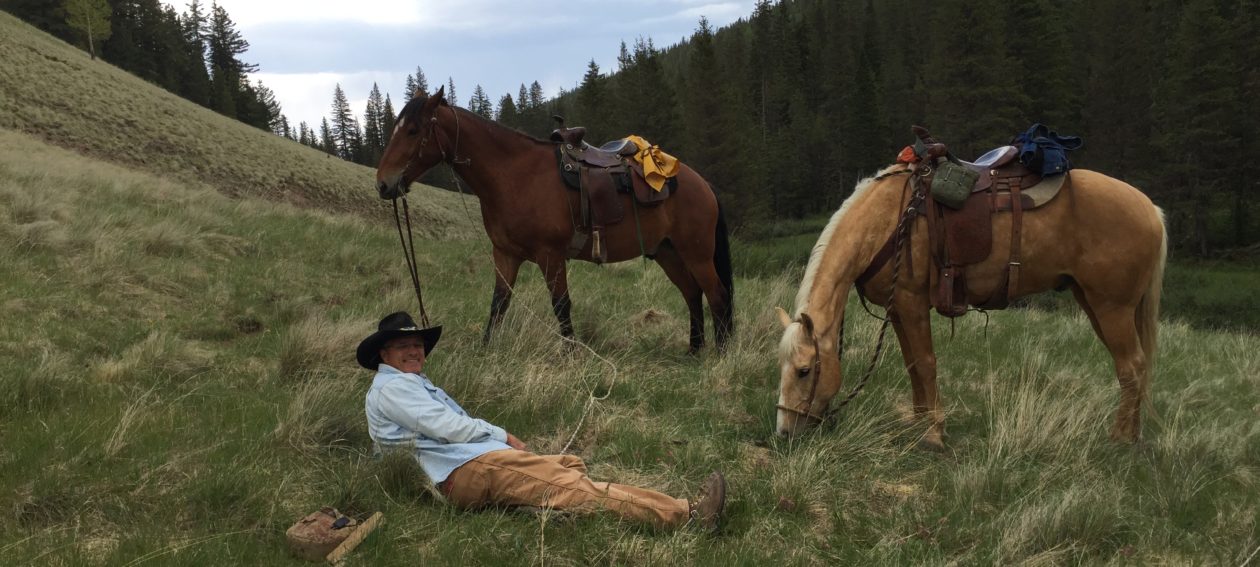
Horses I Have Known

Back in 2018 I composed a blog post about my love for time spent with my horses.  I just re-read it and realized it needs some updating, it now being the final months of 2025. But, rather than just do that, I just thought I’d write something about the horses I have owned that hold the warmest places in my heart. You never forget those you’ve had, and I’ve had a few pretty good ones.  But there is always room for more.

I am getting to the age that I can see that my riding days are numbered, but I still can’t see the end; I have some good years left. My father finally hung up his spurs at age 85, after several months of recovery from being bucked off his horse. He was concerned that if he were seriously injured again, he might not be able to care adequately for my mother, his one and only love and wife of more than 67 years. So, I now have his spurs on my bookshelf.  Spurs handmade by him. I also have a pair of custom made cowboy boots that belonged to my great-grandfather, as well as his cowboy hat, an original Stetson.

I will eventually edit this post to include photos of those things.

So, you can see that this “horse thing” is in my blood. It is a large part of who I am.

I don’t remember my first experiences with horses, but I have an old photo of me riding behind my older sister from probably about 1961.

I must have been about 3 years old. I remember having a pair of chaps and a cowboy hat (probably hand-me-downs from my sister) and a cap gun revolver with a plastic holster. I remember running around with a stick horse, yelling “Hi-yo Silver! Away!”

In my early years I recall my parents taking us kids on horseback rides. In fact, when I was about 4 or 5 years old, I was on a horse with my mother, when the rented horse ran away with us and eventually dumped us in a bar ditch not far from the stables. Mom broke her right knee (I think it was the right one) and I dislocated my left thumb. My enthusiasm for horses, however, remained undaunted and I have lived to have many, many more adventures with horses.

During my elementary school years, my family lived in northwest Florida, where my family first owned horses. My parents bought an old Quarter Horse from a rental stable. Her name was Babe. She was raised as a cutting horse in Texas. My brother and sister and I were allowed to save up our money to buy a pony named Sugar. Sugar taught us about all we needed to know as kids about riding and much about handling a horse. As we grew, we each graduated to riding full-size horses. We began participating in local horse shows, where I learned barrel racing, pole bending, and other athletic horse events.

I remember my brother and I trying to break our pony, Sugar, to ride double. With my dad watching from the arena railing, I would mount up behind my brother and we would start riding. Within a few steps, Sugar would pitch into a full-fledged buck! I would last only a few jumps and off I would go, tail over teakettle, as they say. We did that time after time after time, with Dad laughing to tears and Mom fretting about our safety. We never did get Sugar broke to ride double…unless you could both fit in the saddle, but we sure had fun trying! Wish I could find those old photos.

In my junior high school years, we lived in North Carolina, where we added a horse to our small herd. Dad bought Star, a beautiful sorrel registered Quarter Horse mare, for my mother. We eventually bought a small, but very athletic, appaloosa named Ringo, for my younger sister. Babe eventually became my horse and we learned a lot together. For example, I discovered that there wasn’t a horse in the county that could stay with her in the quarter mile! As we continued to participate in the local horse show events, I often won the “Fastest Horse Around the Arena” event, which usually carried a small purse.

I also loved the Western Rescue Race, which, in our small community, was a hugely popular and raccous event, involving a rider running to one end of the arena and picking up a person from the ground, then returning to the other end of the arena with him/her on behind. There were four barrels set up in the arena. Time started when the rider passed between the first set of barrels, he/she had to pass the second set of barrels, pick up the rider, who had to be astride the horse before passing back past those barrels,  then sprint back to the start.  A qualified time was entered when the horse with both riders passed back past the first set of barrels. Over time, it was discovered that we could get far quicker times if we passed outside the barrels, along the arena rails, which was allowed, as long as the other rules were kept. We took the competition seriously and the runners (those being “rescued”) would dress down for the event: barefoot, jeans rolled up, T-shirt or sometimes no-shirt, in an effort to squeeze just one more tenth of a second off the clock.

So the event generally went as follows: The rider comes into the arena with a horse all fired up and ready to run. They would fire down the rail at a full run on the right side of the arena, passing the first, and then the second barrel. The person being “rescued” would start running as the horse was midway along the rail between those two barrels, in an effort to collide with the horse and rider at a sharp angle about midway between the two barrels at the far end of the arena, as the horse raced around them. A successful “rescue” would result if the runner on the ground was able to reach the horse in full stride, while the rider hooked his/her hand firmly around the saddle horn;  the runner catching the crook of the rider’s elbow and let momentum carry him/her onto the back of the horse, landing behind the rider. If all worked well, the “rescued” would have both legs around the horse when they passed the last barrel and a qualified time would result. A winning time was generally in the area of about 15-17 seconds. Often, however, the runner would mistime the approach to the running horse or miss a grab at the rider’s elbow and get trampled under the pounding hooves, or get tossed by too much momentum completely over the horse and sent crashing into the arena fencing. What fun! I don’t ever recall any serious injuries having occurred…surprisingly.

During our time in North Carolina, from about 1970-74, Dad purchased a farm of 90 acres, on which we built a horse barn and training arena. Dad started a horsemanship school and rented-out and boarded horses. He even helped in training a few unruly horses for specific clients. We eventually owned, I think, 16 horses and a couple of silly goats.  I watched and learned and found I had interest in training horses. I read the official manuals and learned the rules for Western Horsemanship for the show circuit. I found I truly enjoyed working with the horses and it wasn’t just a passing interest.

During that period, Dad, an officer in the U.S. Air Force, accepted a transfer to Arizona, where I spent my high school years. We took four horses and the pony with us and set up our little “ranchette” on five acres in the northeast part of Tucson.  One of the horses we brought with us was my young half-Arabian colt, Char. He was a solid black yearling out of a mare we owned in North Carolina. He was a rambunctious little fellow and we had fun together growing up. He was the first horse I ever raised, broke, and trained on my own. I recognize now how many mistakes I made during his training, but he and I got along just fine. Char was a good teacher.

During the spring of my Junior year in high school, Char turned two years old. All the following summer, I would arise early, clean the pool, which was one of my daily chores, then head down to the stable and get Char saddled and we would ride and train for two hours.  Char was playful more than disobedient, and we had several serious “discussions” during his training, which resulted in me learning some training precepts from experience and him becoming a pretty good horse to ride. He never bucked…at least not from the heart…and he had a comfortable little jog that he could do all day long. He wasn’t much over 14 hands, but he was strong and I was pretty small myself, so we worked out very well together.

About the end of the summer, though, my Dad, who was now retired from the USAF, lost a job prospect and we had to sell a horse, which turned out to be my colt Char. While I was heartbroken, I didn’t complain and I didn’t let it get me down, as I was old enough to understand that we were having financial difficulties, so I transferred my affections and attentions to my mother’s horse, Star. Mom rarely rode horses those days, so I was comfortable with that. It was during that period that Dad took my brother and me on our first horse hunting/packing trips and the direction of my future with horses began to change.

Incidentally, Dad and I were talking just a few years ago and in our reminiscing about the horses we had owned and loved in the past, I talked about that summer I spent breaking and training Char. Dad looked at me with shock and remorse and told me that if he had known that, he would never have sold Char. Dad was always gone to work by the time I arose at about 6:30am and he simply didn’t know. He thought Char wasn’t getting any use, so he was the horse to be sold. So is life, and on it goes.

After graduation from high school, I spent a couple years serving a proselyting mission for the Church of Jesus Christ of Latter-day Saints, after which I headed for college. By that time Mother and Dad had moved to the Springerville/Eagar community in eastern Arizona, at the edge of the White Mountains. They still had a couple horses, so I had the rare opportunity to ride when I visited from school. I married my sweetheart in 1982 and  several years after that, started my career in law enforcement. That made it impossible for me to have horses for many years. During about 1997, however, while living in Farmington, New Mexico, I finally bought a young mustang we named Max, and eventually acquired another horse or two. We had some enjoyable experiences with Max and I took my kids out on the horses as often as I could, but I had little time for horses, as my career occupied most of it.  Of my five kids, only my three daughters have grown to enjoy horses, though horses have not become a part of them as they have with me.  And that’s ok. I’m glad I have at least been able to give them the exposure. Who knows what will come of that as their kids grow.

Max and Ed, taken during a horse camping expedition with one of my daughters

I had to leave my horses when we were transferred overseas for a few years, but toward the end of my career, while my youngest daughter was in high school, I decided to buy another horse and see if that was something she would gravitate toward; she was pretty young during the years we had Max. We were living in Virginia and I found a young mare whose owners were having trouble with her and didn’t have the experience to know what to do with her.  I bought her for a low price and was able to get her settled down and turned her into a nice horse to ride. It was challenging, though, and I learned a few more training precepts that have added to my repertoire. As it turned out, my daughter was more involved in school sports than horses and that was ok, too. I rode the mare, Penny, as often as I could and even engaged in teaching a young woman, whose family I knew, the basics of horsemanship with her. The photo below is a quarter horse I often borrowed, with my youngest daughter, Gina, mounted on Penny.

Penny (left) and her pasture buddy, Robbie

As life would have it, I retired from my government career in 2012 and within a couple of years my daughter graduated from high school and headed off to college. My wife and I decided to make a move to Utah, where most of our kids were living. Just a few months prior to our move, a gate was left open where we kept Penny and she got into a barrel of sweet feed grain, which brought her down with severe founder. Try as I might to help her recover, and after spending thousands of dollars on vet bills in an effort to save her, we had to put her down. My blog post on that sad experience can be found here.

We hadn’t lived long in Salem, Utah, when I decided it was time for me to have another horse. This time, however, there was purpose in my mind, other than simply horse ownership. I was planning, with my father, a horse pack trip from the US/Mexico border to the US/Canada border. I had decided I wanted a gaited horse for this trip and my mind was settled on a Missouri Fox Trotter (due largely to the influence of my good friend, Jon Tanner). After some shopping around, I bought a young  non-registered Fox Trotter gelding, whom I named Ranger.
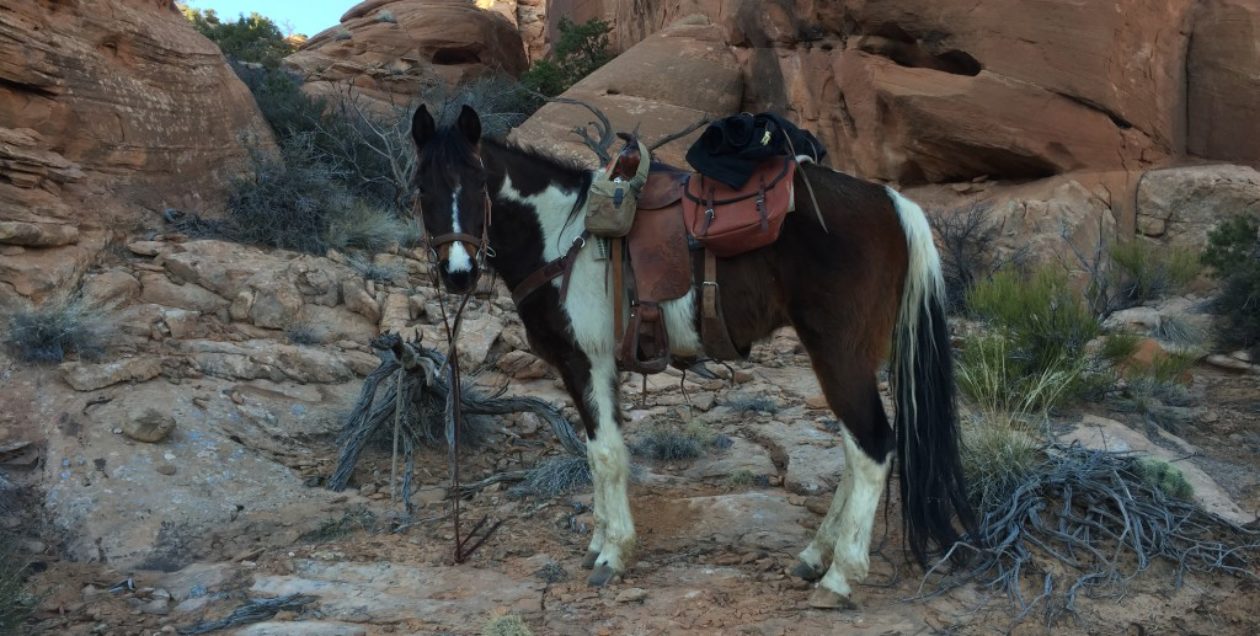
Ranger

He was a tall, thin, rangey gelding that I fell for immediately upon meeting him. His head was a little too big, his neck a little too long, his back a little too short, a little thin across the chest, deep from withers to brisket, strong – he could keep a gait for miles and miles – and he was smooth. He turned out to be the right horse at the right time for me and we soon became a team. He was my primary saddle horse when Dad and I made the first leg of our Mexico-Canada horse pack trip. You can read a detailed log of our trip among my many blog posts. Just search Mexico and they should come up.

As a part of the remuda of horses I bought for the Mexico-Canada pack trip, I also bought a registered MFT mare, named Hot Tin Lizzy V, also known as Lizzy. She turned 4 years old during the first leg of our horse pack trip and she was a peach. Lizzy was essentially green-broke, but she was such a willing and courageous little mare, that she quickly made her way into my heart as well. She eventually became the best trail horse I have ever owned, and I have had some good ones. Lizzy loved to be out on the trail. In the mornings, when I would saddle her up for a ride, she would be excited to get started. Not unruly, mind you, just happy to be heading out for a ride: Ears pointed, nose on the trail, and moving down the trail at a walk that would make Quarter Horses trot to keep up. She had no concerns about leaving the group; if they couldn’t keep up, that was their problem. I loved that! And I loved her.

Me on my favorite trail/mountain horse, Lizzy, in Casto Canyon, central Utah, 2016

Just as we were about to depart for the first leg of our Mexico-Canada horse pack trip, we were still one horse short of what we needed. One night my dad called me and said he had some friends who would give us a mustang…FREE. I like FREE, but I knew from experience that horses are given away for a reason: they couldn’t be sold for some reason.  The last thing we needed on this pack trip was a problematic horse running away across the mountains with our gear on his back! I told my Dad to go take a look and if he approved, we would take him. As it turned out, Jimbo became a very solid and reliable pack and saddle horse. The big problem with him was that he could not be caught and the owner was tired of having to rope him in the corral every time he wanted to use him.

Dad on our mustang, Jimbo, 2015


I worked with him in a small corral for a week and finally got him to let me put a halter on him. After that, we were careful, but he continued to trust us more each day and we had no trouble with him during the pack trip.

A funny story about Jimbo. I once went to load up all my horses for a day trip in Utah. I went out to the corral and was able to catch up three of my four horses. Jimbo would not let me catch him, so, after several frustrating tries, I just told him that was fine and left him alone in the corral. When I returned at the end of the day, I unloaded and brushed the other three horses and let them into the corral. I found Jimbo standing at the gate.  I thought he was waiting for the other horses to return. However, after I let the other three back into the corral, Jimbo kept standing right in front of my face; he wouldn’t leave me. I finally had to put a halter on him and take him out to the trailer and brush him, then lead him back to the corral. It was as if he were telling me he was sorry and was never going to be left behind again! He was never a problem to catch after that.

Before the second leg of our Mexico-Canada trip, I bought a young Quarter Horse gelding I named Reno. He was a hefty youngster, standing about 15.2 hands and weighing in at an estimated 1100 pounds as a 4 year old. He was strong, willing, and calm. He was easy to break as a pack horse and was a great help to us on our trip. He replaced a  QH mare I had borrowed for the first trip that was an unending problem from start to finish. Her name went from Daisy to “that stupid mare” on the second day of our first trip. So, I got rid of her and bought Reno.

Reno taking a break

Reno was a beautiful palomino paint and I enjoyed him. I spent some time training him before our trip and learned he was a good, solid horse. However, being a Quarter Horse, he had to trot to keep up with my gaited horses, which made him a little problematic as a pack horse. I sold him after we finished the second leg of our big pack trip.

Sadly, during the second leg of our Mexico-Canada pack trip, one fateful night, Ranger got caught up in his lead rope and before I could free him, he broke his front left leg and had to be put down. His one fault was that he was prone to panic when surprised or frightened. That was what finally cost him his life. That was a very sad night for me. Dad and I were able to have a friend come out and pick us up, as we just happened to be near a town and near a road. We spent a weekend back at Dad’s house, in Eagar, Arizona,  while I mourned the loss of my friend, Ranger.

My last ride on Ranger

At length, we decided to continue with the pack trip. I had brought along Lizzy as a backup horse, in case something like this happened, so I loaded her up and we continued the trip where we left off.  This was the ride that cemented Lizzy’s place in my heart as the best trail horse I ever had. She became my true friend and I relied on her like I have never relied on another horse. She was the steadying force that kept us moving forward through much of that pack trip and I loved her.

Lizzy

By the time we finished the second leg of our big pack trip, I knew I needed to get a foal out of her. It wasn’t long before I bred her to a registered MFT stallion I had seen locally, with which I was very impressed, DM’s Cherokee Witch Doctor. He was a beautiful black and white pinto, standing 16.1 hands, with white eyes.

DM’s Cherokee Witch Doctor C

In September of 2017, Chief was born.

Lizzy and her colt, Chief

In the meantime, during Lizzy’s pregnancy, I bought a grade Tennessee Walker gelding to replace Ranger. This one was advertised as an unbroken, untrained, 11 year old TWH, whose owner bought him at auction and intended to train and sell him. He just never got around to it. I jogged him around a corral to make sure he actually gaited, found he did, so I bought him. I quickly realized this gelding was not even close to 11 years old. I judged him to be between 6 and 8 years old and had that later confirmed by a vet, who aged him at about 6-7, not yet 8 years old. It didn’t take me long to get him broke and trained to ride. He was no slouch, though, and on his third ride he bucked me off into the grass, because I accidentally gouged him with a spur while getting into the saddle. After that, I was more careful and he was more forgiving.  He was the most beautiful horse I have owned. A beautifully dappled palomino with a perfectly proportioned head, pointed ears, and a wonderful running walk gait. I named him J. Golden.  Here’s why. What a great trail horse he became.

He and I spent a lot of time together on some pretty wonderful trails. I eventually took him on a moose hunt in Alaska, which I considered to be a post-graduate course in trailcraft for horses. He was amazing! I remember one evening, my hunting buddy and I were heading back to our camp. It was getting dark and we did not want to get caught after dark out on the trail in the dense forest in grizzly bear country.  J set a killer pace of around 7 miles per hour, tromping in a space-eating running-walk through almost knee deep tundra, up and down long hills, until my buddy behind me yelled, “Hey, slow him down! He’s gonna kill us!”

After I got home from that trip, I decided to sell J. He was a great horse, but just before the Alaska trip, he somehow injured a rear hoof just into the coronet. It was a deep puncture wound. The vet opined that it would not lame him and that it was ok to take him on the Alaska trip, but that he would likely have a quarter crack in that hoof ever after. That was pretty much a death sentence for the the mileage I intended to put on him. A horse with a severe quarter crack just wouldn’t make it without special shoeing and care.

At that time, I had a client for whom I was searching for just the right horse. She had experienced a traumatic injury on her previous horse and she had severe anxiety as a result. However, her love for horses and riding would not allow her to give up. I just had to find her the right horse. While I was looking, I had taken her and her husband out a couple times to give them a chance to try gaited horses. I put her on Lizzy and him on J Golden. We hadn’t ridden half an hour, before he rode up next to me and said, “I’ve been riding all my life, but I never enjoyed a ride like I have on this horse!” Meanwhile, the wife kept saying how much she liked Lizzy, to which I repeatedly responded, “Sorry, Lizzy is not for sale. She’s mine!”  Well, when I decided to sell J, I called them and offered them a special deal on him, disclosing fully the issue with his rear hoof as the reason I was selling him. It was too soon to be able to tell one way or the other, but I told them that injury might heal fully and be no problem, but that it would likely result in a quarter crack that might require special shoes and farriery. They happily bought him. As it turns out, the injury healed fully, leaving only a small wave in his hoof below the injury to the coronet. No Quarter crack, no special care, no lameness.

Not long after that, this couple contacted me with several videos of horses they had been trying out, asking for my opinion. I saw none of them as being right for this lady. I knew they would not be happy with any of them and she would likely end up not being able to overcome her anxiety. One night the thought occurred to me that she needed Lizzy! Oh, how I struggled with that thought. I not only worried that I would regret selling Lizzy, but I worried that I might cause them financial hardship, because I could not afford to let Lizzy go cheaply, since I would have to replace her. She was just too good of a horse. I finally decided on the minimum amount at which I could afford to part with Lizzy and gave them a call.

I had devised a plan, in which I would tell them I might have found the right horse for them, but warn them that the owner wanted a high price for her. If they said they could afford her, I would tell them I would speak to the owner and see what might be done. That way I would be sure not to put this young couple into financial hardship, because I knew they loved Lizzy and would try to buy her even if they could not afford her.

Me on Lizzy

Over the phone, I spoke to the young woman and described the horse I had found for her. It was a young mare, a registered Missouri Fox Trotter, about 5-6 years old, sorrel, very good conformation, gentle, yet energetic, an excellent trail horse, with a nice gait. I said, “however, the owner is quite proud of her and is asking $xxxxx for her.” As I described her, I heard her husband in the background, jokingly say, “Is her name Lizzy?” to which she responded, “Oh, be quiet!” The woman then told me she was very interested in this mare and would like to see her. She explained that she and her husband had set aside money they had budgeted specifically for horses and that even after buying J Golden they had sufficient remaining to purchase this mare, if she worked out to be the right one. I was both elated and saddened, when I told her the mare, was, in fact, Lizzy. I could not resist, however, the joy in her voice as she screamed and cried and embraced her husband, while I listened.

I have never once, since that day, regretted having sold those two horses to that young family. I have visited them since and even gone on rides with them. The horses. are content to be together and they are ridden multiple times weekly.  They are all one happy family.

As I now needed to replace my primary horses, I began the search for a pair of horses that would suit my needs. I still had the mustang, Jimbo, but planned on moving him to another home. Eventually, I found him a home with a woman in Arizona, to whom I gave him, since he was given to me. She kept him for a couple years, then moved him on to a friend of hers.

I had a good friend during this period, for whom I had done some work training horses.  As a form of payment, he gave me two horses he had acquired that weren’t working out for him. One was a 16 year old registered Tennessee Walking Horse we called Oreo, she was a black and white pinto mare, 15.1 hands, very pretty, but a little spoiled and very herd-bound. I worked with her several weeks and had her behaving well. She was a pleasure to ride, except for when one tried to leave a group, at which time she became anxious, but not unmanageable for someone with even meager riding skills.

The other horse was a non-registered Rocky Mountain Gaited Horse named Calypso. She was a 14 year old mare, black, with a white star on the forehead. She stood about 15 hands, as I recall, had decent RM conformation, was not hampered by Cushings Disease (which is common in the breed), and had the very sweetest and most comfortable canter I have ever ridden. She had some good training somewhere in her background, but it was buried under years of non-use by owners who were probably less than competent horse people. I brought her back up to par within several weeks and was quite pleased with her.

I offered both mares for sale. You can read about them under the “Horses for Sale” tab on the website.

During that era, I began to gain a reputation, or rather my horses did, for being good, solid, competent trail horses.  A woman contacted me, saying she had a horse that was giving her problems and wondered if I would take him on for training, to see if I could turn him into a horse she was comfortable riding on trails. She explained that she had already paid two different trainers, but both were unsuccessful in turning him into a reliable trail horse. He was spooky and excitable and she was afraid to ride him outside an arena. We agreed on a program and a price and I drove out to pick him up. He was a beautiful black non-registered Tennessee Walking Horse gelding about 15.3 hands, named Apollo. He allowed us to catch him in the corral, but once he realized we were taking him from his stable mate out to a strange trailer, the trouble began. I was able to keep him under control, but he was quite unruly and anxious. I could see this was going to be a challenge. While I was there, however, I noticed that this woman had another horse in the corral that was almost the spitting image of Oreo! It was, of course, a Quarter Horse, but the likeness was such that if one did not know both horses, they might be mistaken for each other.

Apollo

On my way home, I stopped by an indoor arena where I had a membership, thinking that if this horse were to buck me off the first time I rode him, I would prefer the soft sand of the arena to the hard, rocky ground of a desert trail. After getting him saddled up at the trailer, I led him toward the arena entrance. There was a wet area on the pavement, where a stream of water had recently run, about a foot wide. Apollo would not cross that strip of dark pavement! I finally coaxed him across and he jumped high in the air to get across it, nearly falling on the slick pavement! I could see my work was cut out for me to turn him into a competent trail horse. However, when I rode him around the arena I discovered that he was nicely trained and had an incredibly smooth gait. I was quite taken with him. I ended up calling the woman and asking if she might be interested in a trade for a registered Tennessee Walking Horse mare that looked like a bookend match to her Quarter Horse. In the end, we made a straight across trade – Apollo for Oreo.

I enjoyed training Apollo and it wasn’t long before he became one of the best trail horses I have had. He just lacked experience and that’s what I gave him. Eventually, he would do anything I asked of him, calmly and confidently. I took him on several long horse pack trips, one of which was a continuation of my Mexico-Canada pack trip. He and Calypso were my horses on a week’s ride from Flagstaff, Arizona to the South Rim of the Grand Canyon.  I also took him to Alaska on a moose hunt, like I did with J Golden, and put him through that post-graduate trail horse course.

However, during the Alaska trip, which is very hard on both horse and man, Apollo lost a lot of weight. I could not keep the weight on him. In his weakness at the end of the trip, he somehow injured his back in the lumbar area, similar to a lower back injury in a human. It produced a swelling that, from experience, I know can only be healed with time off, without any hard load or long rides on his back. I gave him about 6 months off, but he just wasn’t regaining his weight as I had hoped. So, I decided it would be best to move him on to another owner, who would not use him the way I needed to use a horse. He was purchased by a woman out of eastern Utah, who was very excited to have him. I haven’t heard from them since. I miss that horse.

I had Apollo and Calypso during the same period of time. They looked so much alike, other than their conformation, that they made quite a pair for me. I used them both for riding and packing and they made a number of trips together with me.
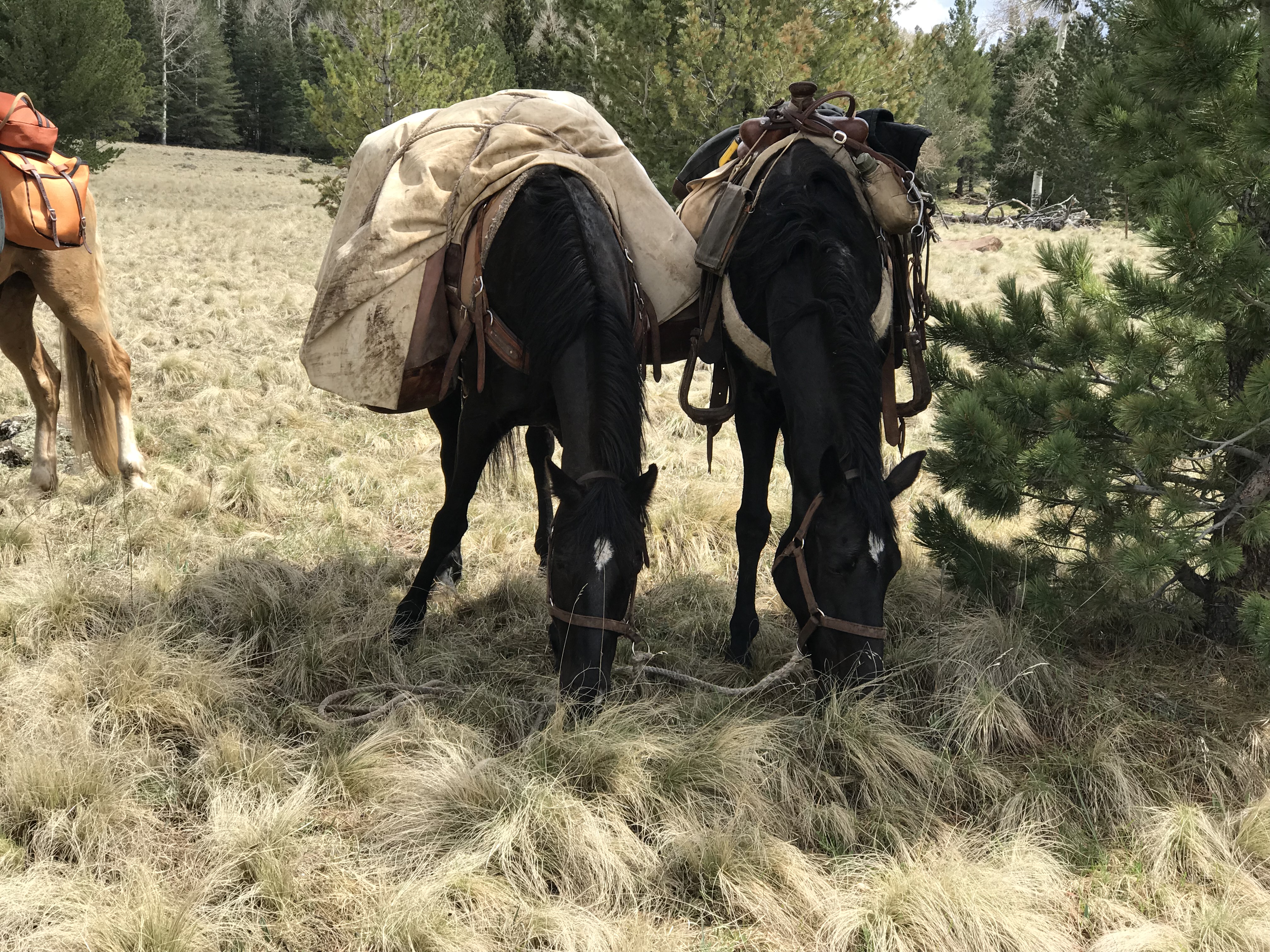
However, Calypso, just wasn’t the horse I wanted to keep. After I sold Apollo, I also moved Calypso on to another owner, a friend I knew in Arizona. She needed a good, solid horse, as she was at that age where getting dumped in the dirt just wasn’t a good idea. I sold her Calypso under a 30-day trial period, which was my way of making sure the right owner and the right horse got together. I had no problem returning the purchase price if the two turned out not to be compatible, which, turned out to be the case with Calypso.  She was a little too herd-bound and her anxiety when being separated from other horses made her owner anxious as well, so I asked the woman to please drop her off at my father’s place in Eagar, Arizona and I would return the full purchase price.

Well, you will recall from earlier in this very long post, that I mentioned that Lizzy had a colt we called Chief. Around this time he was staying at my father’s place while he grew up. I weaned him at 6 months of age, by leaving him at Dad’s place in Arizona, among several other horses. He was now about 18 months old. When the above-mentioned lady returned Calypso, Dad simply put her in with his other horses, not even thinking about little old Chief. It wasn’t long before we realized our mistake and by that time, Calypso was pregnant with Chief’s foal.

I eventually picked up both Chief and Calypso and returned them to my place in Utah, where I decided to keep Calypso until she foaled, to see what would turn up as Chief’s get out of a black Rocky Mountain mare. In the meantime, I had Chief gelded.

That’s my life-lesson to young men: Unexpected pregnancy…now he’s a gelding!

During Calypso’s pregnancy, I came to own another TWH gelding, by the name of Copper. He came into my hands the same way Apollo did, essentially. A fellow asked me to put some trail training on him, because he was a little rambunctious and the owner did not trust him on the trail. I took him on and eventually bought him from the owner. He was a pretty good match for Chief, being just a tad smaller, but very similar in color. I made several pack trips with the two and enjoyed both of them on some very difficult trails. Copper turned out to be an excellent trail horse and I eventually sold him as such. He was not one I intended to keep for long, but I enjoyed him while I owned him.

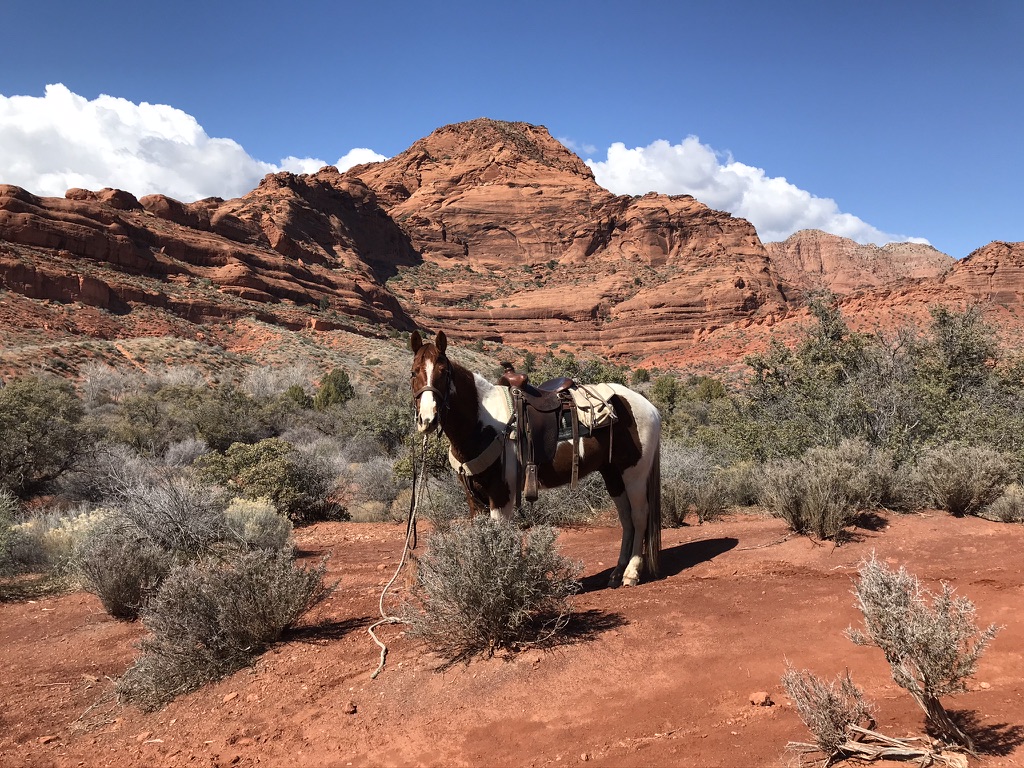
Copper


During this period, several other horses came and went through my hands, both for training reasons and selling/buying for clients who were searching for their “heart horse.” One that was special to my heart was Missy.  She was a registered Missouri Fox Trotter, standing about 16 hands, built like a Ferrari! She was beautiful and I loved her. Her story is a rough one and I will tell it like it was.

One day my good riding buddy called me and said, “Hey, we’re going to the Bob Marshal Wilderness Area for a pack trip! Wanna go?” I answered with a resounding, “Yes! When are we going?”

“Monday.”  It was Wednesday. I didn’t even have time to get my horse, J Golden, re-shod for the trip!

So, Monday morning, we’re in the truck, loaded trailer behind, heading north on I-15, when my buddy turns to me and says, “Oh, by the way, we’re stopping in Blackfoot, Idaho to pick up a couple of horses I bought over the phone. They’re not broke. Do you think you can have them ready to pack for us for this trip?”  I took a deep swallow and said, “Well, I’ll give it a try.”

So, we stopped off at this old ranch, where an old fellow had been in the horse breeding business and was selling out. He had several Missouri Fox Trotter brood mares left and my buddy had made a deal for two of them. I got in the corral and began moving them around and noticed that one of them walked with a barely noticeable limp. Apparently she had an old injury to one of her front shoulders, which was probably why she was a brood mare most of her life. I recommended he pass on that one.

The other mare, however, was beautiful! She was 7 years old and not broke to saddle.  She moved well, like a ballerina moves. She was well-proportioned, sleek and slim, like a Ferrari. I liked her right off. I told my buddy this one was a keeper. She was just broke enough to be catchable and to lead, so I worked with her a few minutes to get to know her and within a half hour I was able to load her into the trailer with the other 4 horses.

That night we got her to wear her first saddle. It was a pack saddle. She bucked and snorted and nearly got it off, but by the end of the evening, she had calmed down and allowed us to saddle and unsaddle her. The following day, at the trailhead at the Bob Marshall in Montana, I was able to trim her hooves a little and we put a pack saddle on her back with a light load and lead her on a short trail ride then back to camp. It was difficult and there were a few complications, but she finally figured it out. The following morning, we took her out fully loaded with all the camp gear needed for four people for 5 days. She had a load on. It was too much for her to carry under the circumstances and I still feel guilty about that. We had a small wreck near the beginning of the trail, when her pack turned, but after re-settling the pack she carried on and did well…for awhile.

After about 7-8 miles on the trail, it was becoming obvious she was laboring and tiring. By the time we had gone about 12 miles, she was done. At one point she just fell over and refused to move. We finally got her up and we went on.  We stopped short of our goal and made camp as soon as we found a suitable spot. By that time, Missy was exhausted. We unpacked her and it soon became apparent to me that, being barefoot and under a heavy load, she had road-foundered. We stayed at that camp for the next three days, riding out each day from that spot, leaving Missy and another horse in camp. Missy could hardly move, her feet were so sore and swollen. I led her over to the nearby stream and had her stand in the Ice-cold stream for several hours. I think it helped. We ended up cutting our trip short by a couple days. We moved our camp about 2 miles back toward our trailhead, in preparation for our departure the following day.

By that time,  my horse, J Golden, had lost 3 of his shoes and was getting tender footed as well. So, on our departure day, I headed out early, on my horse, leading Missy with a very light pack. The rest of our gear was loaded onto the remainder of the saddle horses and the rest of the group came on later. I, J Golden, and Missy rode out the 10 miles from our camp to the trailhead by ourselves, so that we could take our time and just make it as easy on Missy and J as possible. It worked out pretty well and Missy seemed to get less sore as we went. By the time we made the trailhead the rest of the group had caught and passed us, but we weren’t far behind in arriving. Missy made the trip home ok, though she was still very sore.

Once home, I took Missy to my place, where I kept her in a soft, sandy arena, while her hooves healed up. After about 30 days, I decided I would begin to break her to the riding saddle. I figured that while her hooves were still a little tender, she would have less desire to try to buck with me. I was right and within a week or so, I was riding her and the exercise seemed to help her recovery. Because of what we had put her through from the start, I found myself treating Missy with an extra measure of tenderness and she responded in kind. I never actually owned Missy, but I ended up keeping her for about a year before I finally put her up for sale. She was sold to a fellow in southern Utah, who appreciated her sleek beauty and smooth movement as I did.

Missy earned a very special place in my heart, due to her heart. She went through some pretty tough times and kept on going forward all the time. Her courage in the face of difficulty, with no complaints or problems, when she could have given plenty, is still an inspiration to me.

So, back to the main story. 11 months after the unexpected encounter between a just barely old enough Chief and 15 year old Calypso, Trooper was born. My mother chose the name for him months before he departed the womb. I was there in the corral before he stood for the first time.  We had a little problem with Calypso, as it became apparent this was her first foal. There is something that can happen with older mares with their first foal: They sometimes don’t quite know what to do. It seems their natural motherly instincts fade over time, never having been awakened in their early life. Calypso would not allow the foal to nurse. She acted like she knew she was supposed to be doing something, but she could not figure it out. She was careful about Trooper, knew he was important to her, but she just couldn’t quite figure things out. She wanted to keep two eyes on him at all times, so when he tried to go back to start nursing, she would turn her hindquarters away from him, so that she could keep him directly in front of her: both eyes on him.

I began to worry after close to 6 hours had gone by without Trooper being able to get his load of colostrum in that first nursing, which is so critical to the health of the foal.

So, I engaged two people to help me. I had one person hold Calypso’s head, while the other stood by her off-side hind quarters and would not allow her to turn. I, then, helped Trooper stand and guided his muzzle to Calypso’s udders. As soon as he began hungrily suckling, it appeared that Calypso’s maternal instincts suddenly awakened and she knew exactly what to do. She immediately relaxed and we had no further problems or concerns about her caring for her baby. She was a very good and careful mother. I weaned Trooper at four months and shortly thereafter sold Calypso to a family in Cedar City, Utah.

Since that time, both Chief and Trooper have grown into the two horses I intend to keep until the time comes that I can no longer stay in the saddle and have to hang up my spurs. These two have become two of the best horses I could ever ask for.  They are competent trail horses, and yet are calm enough for my grandchildren to ride. Both seem to understand that my young grandkids need special care. Yet when I am in the saddle, they are energetic and will do whatever I ask of them. I could not imagine having better horses for my needs.

There have been many horses in my life and most of them hold a warm spot in my heart. It has been my privilege to have owned, trained, ridden, and enjoyed so many good ones in my time.

With that, I will end this post with the following thoughts from the post that inspired me to write this one:

When I am in the saddle, there is no age: I am not young. I am not old; there simply isn’t any age.

When I am in the saddle, the ride is the destination.  Where we are headed is irrelevant.

Happy Trails.

TH

Cleveland Spring Trail, Blue Range Primitive Area, Arizona

During February, 2024, my good friend, Derek Habel, and I made a trip into Arizona for a ride in the Blue Range Primitive Area, in southeastern Arizona. “The Blue” as the area is known locally, is one of my favorite places in all the world. It is essentially a low mountain range split by the drainage of the Blue River, which runs south into a confluence with the San Francisco River. In 1905 Forest Service Employee W.H.B. Kent described the Blue Range as “no discernible mountain range, but rather a chaotic mass of very precipitous hills” (USFS website).  It is an apt description. The Arizona side is a designated Primitive Area, while portions in New Mexico are designated Wilderness Areas, according to the Apache-Sitgreaves USFS website. It was the last primitive area designated in the U.S. National Forest system.

When I was a young 15 years old, I was introduced to “The Blue” by my father, who took my younger brother and I on our first real deer hunt with horses. He drove us down the dirt road known as Red Hill Road, to a particularly wide spot about 3/4 of the way to the bottom, where we made our camp and stayed a few days. During that short stay, I grew to love that area and it has had a lasting impact on my life.

In about 1990 or so, I took my son, my sister, and her boys on a backpack trip into the area known as Tut Creek. We hiked up a trail to a saddle just north of Foote Creek Mesa, where we made camp. The following morning, we hiked about a mile to Cleveland Spring, which was nothing more than a short pipe sticking out from under a rock, where we filled out canteens. From that day, I have wished to ride Cleveland Spring Trail from Tut Creek to Foote Creek.

So, with my riding buddy, Derek, I finally checked off that bucket list box .

The trailhead from which we started is the Tut Creek Trailhead. Getting there is pretty simple, but not without some adventure. Take US 191 south from Alpine, Arizona about 14.2 miles (You can come up from the Safford area, but this highway was once designated US 666 and is definitely not recommended for pulling a trailer longer than about 25 feet) then turn east on Red Hill Road.

Red Hill road, is a regularly maintained dirt road that winds down fairly steeply into the Blue. Near the bottom. I say “regularly maintained” however, that is rather subjective. It gets graded now and again. Don’t try it when it’s been raining. You may not make it. Follow that road downhill somewhere around 15-ish miles and you’ll pass the trailhead on the west side of the road. It’s about a quarter-mile from the Blue River crossing, so if you get to the river, you passed it.

Now, you can also get there by taking Blue Road, which heads south from US 180 just east of Alpine, Arizona. This road is a much better road, still dirt, but maintained more often, and less steep than Red Hill Road. When you reach Blue Crossing after about 22 miles, where Red Hill Road intersects Blue Road, turn north on Red Hill Road, cross the Blue River, and head up about a quarter mile and you should see a sign indicating the turnoff on the two-track to the trailhead. If you are towing a horse trailer, look to the east side of Red Hill Road and find a place where you can pull off and park. Dispersed camping is allowed, with the standard 14-day stay limit.

So, that settled, head west on the two-track about a half mile and you will find the official trailhead (coordinates: 33.63125, -109.1098). Third warning: Don’t try taking your trailer in there.

There you will find the trailhead signage, indicating it is designated for foot and equine travel; no mechanized vehicles.

Follow the trail until you cross Bush Creek. Somewhere along there you will find a trail sign indicating the various trails you can take from there. If you go right, you can take Red Hill Trail, which will take you to the top of the Blue Drainage, to a trailhead you would would have passed on the way in on Red Hill Road. If you go straight west, as we did, you will be on Cleveland Springs Trail.

Cleveland Springs Trail will take you up a lower canyon for about a mile or so, then abruptly turn up a side hill on a switchback to the south. As you climb the side hill, the trail will eventually sweep back toward the west to take you across a saddle on the north end of Foot Creek Mesa. There are a number of nice camp areas on that saddle and it is the place where I camped with my sister, her sons, and my son those many years ago.

Continue on westward on the trail, through a fence gap and you will begin your descent into Foot Creek. This trail is a bit sketchy, as there has been no maintenance of it in probably the past 50 years, but if you keep your eyes peeled, you can find your way across and down the mountainside to the creek.

(Click on a photo to get full-size)


Once at Foot Creek, you will see the trail intersection at a fence gap. If you turn right, or north, through the gap, you will begin the ascent to the top of Foot Creek Trail. If you turn to the left, or south, following the creek as we did, you will descend to the Blue River, however, the trail is not well marked once you leave the creek bottom. We must have made a wrong turn once we got into the meadows at the bottom, because we had to do a bit of bushwhacking to get up to Blue Road.

From there, we followed Blue Road eastward until we got back to Blue Crossing, turned north onto Red Hill Road, crossed the Blue River, and returned to our point of origin. The ride comprised a loop of about 6.5 miles and took us most of about 6 hours. Now, we were riding gaited horses, but there are mighty few places on that ride where one would be able to gait along at a decent pace. With the ups and downs, and switchbacks, and bushwhacking, I guess about 1 mile per hour was about right.

Here’s a compilation of some videos we took on the ride (or see my YouTube channel at Western Trail Rider).

Since the Wallow Fire of 2011, many of the trails in The Blue, such as Foot Creek Trail, KP Mesa Trail, Grant Creek Trail, and Steeple Creek Trail, all of which were once nationally know trails, have nearly disappeared. I have been told Grant Creek Trail is impassable, but I have made it all the way down. I was told Red Hill Trail is impassable, but I and a couple friends made it all the way from the bottom to the top. I have been told Foot Creek Trail is impassable, as well, and it may be, above Cleveland Springs Trail, but we were able to make it from there to the Blue. I guess a lot depends on how badly you want to get from one place to another and how much faith you have in your horses.

For me, as I said before, this was a bucket-list ride I had been wanting to do for nearly 35 years and I enjoyed every minute of it.   While the trail has not been maintained in many years, the wildlife and cattle use it, as do the cowboys who still run cattle in the area, but it sees very little travel from visitors. There are places on most of the trails where one really has to hunt around to find the old trail, but if you know what to look for, it can be found.

One day, if life lets me, I would love to spend a couple summers riding up and down all those trails and restore and re-mark them all, so hikers and horse riders can once again enjoy my favorite place in all the world.

Happy Trails.

TH

I finished my first saddle!

Somewhere around 15 years ago, I decided I would like to learn to make saddles. I began to acquire tools of the trade and bought a number of books on the subject, including the full three-volume set, The Stohlman Encylopedia of Saddle Making, which I have found to be a wonderful resource. I started by making a few items of cowboy gear, such as chaps and chinks, a few knife sheaths and handgun holsters, spur straps, and other useful items, which taught me several valuable skills, such as hand-stitching heavy leather and decorative stamping and carving.

I then started doing various repairs on older saddles, eventually doing a couple of complete restorations, which taught me the basics of how saddles are made and put together.  During this developmental period, I started putting together in my mind what I would want in a saddle of my own. I decided that for my uses, what I needed was a very heavy-duty, but lightweight saddle.  I considered everything from “Aussie” stock saddles to the Santa Fe style western saddle from the 1850s, to modern lightweight saddles, but finally decided that my taste was definitely centered on the late 1800s stock saddles. So, the research began.

After many years of just reading, perusing pages of photos, and looking over saddles from that period in the American west, I finally got up the courage to make the investment in tools and materials to start my own saddle. I will warn the reader here, that this investment in hard cash money, to buy the necessary tools to do this thing right, is no small thing. I am sure that in my sparsely outfitted saddle shop I have well over $2,000 invested in tools by now, most of which are tiny little hand tools, such as stamps, pliers, hammers, and cutting tools. On top of that, a side of top-quality saddle skirting leather now runs in excess of $300 and two are required to make one western style saddle. On top of that, a good saddle tree will run  $400-800, including shipping. When you can buy a good used saddle for $300, this is something you have to weigh in the balance.

Well, in 2021, a friend of mine encouraged me to build a saddle. He even fronted me enough money to buy the leather and tree, provided the saddle would be for him. So, I jumped in. After a bit of research and consultation with the friend-client, it was decided a Wade-style saddle would suit him. I decided on the  Timberline Wade tree, made by Timberline Saddle Trees, Vernal, Utah. It is their “flagship” saddle tree. After consulting with them on the phone, I sent them the custom measurements I wanted in the tree, to suit my client’s horse, and away we went. I also ordered two sides of leather, one 13/15 oz and one 11/12 oz Herman Oak skirting leather from Montana Leather, Billings, Montana.  I also ordered the saddlery hardware from them.

I was very pleased with the quality of the saddle tree. It was money well-spent.

The first item of business was to smooth the pommel to bars junction and dress the saddle horn.

Then comes the ground seat. I elected to make a leather “seat strainer”, rather than the more commonly used tin strainer, as I have read it makes a more comfortable seat. I used the heaviest leather I had on hand, which worked out very nicely.

Next was the gullet covering.

After that, I made the ground seat.  Then it was time to decide on the decorative stamping and/or carving I would do to make the saddle attractive. I had a hard time deciding on this.

Carving designs in leather is not difficult, but the artistry involved is quite complicated. Each saddler or leatherworker tends to follow certain conventions in design, but eventually creates his/her own style and that style becomes his/her “signature” and will identify his/her work ever after. That, to me, makes it a pretty weighty thing. As I have not yet quite settled on my particular style, and as messing up a detailed carving on a saddle can absolutely ruin it and waste much time, labor and cost, I decided to go with stamping designs. After a number of trials and sample stampings, I settled on the design you see below. I then made the Sam Stagg front rigging parts and the stirrup leathers, which I then followed with the back of the cantle.

The stamps used, alternating between the two, are Craftool Pro # D2166 and Craftool #D438. I used a 3/32 grooved tool (of which I do not know the technical name) to make an outline for the design, which helped keep the stamping lines smooth and symetrical.

After installing the gullet cover and the pommel cover, I oiled and stained them with Tandy’s Pro Dye in Dark Brown. The Dark Brown color darkens the leather to a dark reddish-brown, which I find very pleasing. Oiling the leather with warm neatsfoot oil (100% pure neatsfoot only, as neatsfoot compound oil has additives that can harm leather) beforehand helps the stain to absorb more evenly into the leather. Adding more coats and allowing drying/absorption time between coats will darken the color a little with each coat.

I then finished the horn and wrapped it with a latigo horn wrap. I was quite pleased with the result.

Along about this time, I also covered the cinch rings with leather. Leather-covered cinch rings were fairly common in the 1880s. The leather helped the latigo slide over the ring easily, when cinching down a saddle on the horse and keeps the unsightly rusty rings covered. Nowadays, we have stainless steel cinch rings, but in those days they were just plain steel and rust was a problem.

Next came the skirts, which I made out of 13/15 oz leather with a rounded design, reminiscent of the 1880s California style (the Texas style was squared skirts). I made the skirts a bit shorter than might be seen on vintage 1880s saddles, as I wanted to keep weight down.  I used a heavy paper throughout the building process to make patterns, which, in turn, makes the saddle build repeatable and easier the next time. I cut the skirting leather to my patterns, then wet-formed the skirts to the tree bars by tacking them in place tightly until they dried. I then glued and hand stitched the fleece to the skirts.

For me, stitching a pair of saddle skirts takes a good 8-10 hours of pretty intense concentration and labor (not to mention sore fingers!).  In the future, I fully intend to spend the $1,500-2,000 to purchase a stitching machine, which would turn that job into a very simple 15-minute job. I used a synthetic waxed thread, which was what I normally hand stitch with. The wax helps the thread slide through the leather and settle with a uniform tension, which helps the stitches to appear even and uniform. I had to remove  as much of the wax as possible by wiping the thread with leather scraps, as the wax pulls the fleece into the hole, causing tangles and knots. Stitching saddle skirts is a tedious job.

I then designed and made the front and rear jockeys, stained them, and connected the rear jockeys with a saddle braid. In this photo you also see the seat leather, which has been cased and is being molded to the saddle by means of a bench strap. The strap is part of the saddle stand and is put under tension by means of a ratcheting lever. When the seat leather dries, it will be trimmed to final size and readied for installation.

The next process was to make the seat and side jockeys. I decided, based on a video from the YouTube channel, Agar France, to stitch the side jockeys to the seat leather, making the three parts into one. Traditionally, the seat leather was installed, then the side jockeys, the purpose of which was to prevent pinching the rider’s leg between the seat and stirrup leathers.  These were installed as separate pieces. These side jockeys were often tacked to the tree bars with brass tacks to keep them firmly in place during use. Stitching them to the seat leather simplified the installation of the seat leather, making it more like a modern saddle, which incorporates both the side and front jockeys into a one-piece seat leather.

Having watched a particular video by Agar France, which no longer appears on his channel, I decided to place the front jockeys underneath the Sam Stagg front rigging, as shown above, however, once I got the saddle finished, I discovered this configuration interfered with the movement of the stirrups. It caused the inner stirrup leather to pinch between the front jockey and the cinch ring.  The solution was to move the front jockey to cover the rigging straps, which freed up the movement range of the stirrup leathers and was still in keeping with design conventions I have seen in the 1880s stock saddles. In the end, I was pleased with the result.

At this point, the next order of business was to trim the cantle and do the cantle binding. This is, in my mind, is the most difficult and critical part of the saddle making process. If it is done well, nobody notices. If it is done poorly, it stands out and becomes the most noticeable part of the saddle. I have read that the mark of an excellent saddle maker is that the stitches on the backside of the cantle are straight and even. Getting the frontside of the cantle binding stitching straight and even is difficult enough, but getting the stitching awl to penetrate more than an inch of saddle leather at exactly the right angle and exit at exactly the right place, time after time, in a straight and even line, is extremely difficult! I can testify that this takes much experience and effort to achieve. I have stitched several cantle bindings and the results show that I remain a rank amateur saddle maker.

However, I don’t let that get me down and discouraged. I have noticed that in the current generation of saddle makers, most take pains to hide the stitching on the backside of the cantle by various means. Some make a slit in the back edge of the cantle binding leather, such that the stitching on the backside comes out inside the slit, which is then glued down smooth after the stitching is done. Others cut decorative design into the backside of the binding leather and do not run their stitching into it at all, but affix it to the back of the cantle with brass button tacks.

I have never cared much for the Cheyenne Roll, which is the large roll at the top of the cantle, found on modern saddles, especially roping saddles with low cantles. I much prefer the simple cantle binding found on vintage stock saddles, which is what I elected to put on my saddle. I do, however, like the cantle binding to be thick enough to provide a decent hand-hold, making it easier to carry or move the saddle. My cantle binding is made of 12 oz leather, skived thinner on the backside to make forming and stitching easier, covering three layers of heavier leather made up of the seat leather, a spacer leather, and the cantle back leather. This seems to come out about to my taste for the cantle binding thickness.

The cantle binding leather was then cased (soaked, then allowed to sit overnight in a plastic bag) to make it soft and pliable. The edges were then edged with a #3 round edger to make them round and smooth. I used a groover to make a stitching groove along both the front and back edges to allow the stitches to rest below the level of the surface of the leather, to protect the stitches from wear. The groove also provided a guide to help me get the stitching awl to exit in the right place on the backside of the cantle.  I also used an overstitch wheel in the groove on the front edge to mark where the awl would penetrate for each stitch. After preparing the cantle binding leather, I stretched it tight over the cantle, forming it into place using a bone smoother.  I then tacked it into place with shoe tacks. Each tack penetrates through a mark made by the overstitch wheel, so that the hole will eventually become an awl hole and thus be hidden by a stitch.

Once the cantle binding is dry, it retains its form. I then applied Barge contact cement to the cantle top and the cantle binding. Once the cement had dried to where it was no longer tacky, the binding was carefully put into place. Note here that once the two surfaces to which contact cement has been applied make contact, they are pretty much stuck. I used a piece of paper between the pieces and slowly removed it as I got things properly placed.

Once the cantle binding is properly placed on the cantle, the stitching can commence!

Several cantle bindings ago, I bought the best awl and awl blades offered by Tandy Leather. The haft ran nearly $30 and each blade ran about $16. I broke three of those blades within the first several inches of cantle stitching. I examined the blades and discovered that while the blades were very sharp and penetrated the leather easily, they were designed with a natural breaking point right above the point at which they enter the  haft. A very poor design for stitching cantle bindings! I returned to my local Tandy Leather store and discussed the problem with them. They happily refunded my money for the haft and the blades. I then bought their less expensive awl haft – $12.99 – and a variety of awl blades in the $3-4 price range. I have found that I can sharpen these less expensive blades on a very fine water stone and strop them on a leather strop with polishing compound and they penetrate leather more smoothly than the expensive blades. Since that time, I have broken exactly one awl blade. These blades are soft enough that I can put pressure on them to make them penetrate thick cantle leather and exit where I want them to without snapping off the blade in the leather.  Yet they are hard enough to retain their sharpness for a reasonable amount of stitching.

So, to continue…

My cantle binding stitching came out pretty well on the front. The backside, however, is a different story. I have seen worse, but not often. I am not proud of the way the backside stitching came out, but it is what it is, as they say. I still have much to learn (In my defense, the photos make the stitching appear even more rough and uneven than it really is. Some of what you see in the photos is the wax residue from the thread.). On the other hand, if I don’t tell anybody, nobody will look for it and it will go largely unnoticed. Sigh…

With the cantle binding in place, it was time to oil and stain the entire assembly and mount the saddle skirts permanently. To mount the skirts, the traditional method entails installing saddle strings in the leather of the saddle skirts before the fleece is attached, then drilling corresponding holes all the way through all the saddle leather and the tree bars, then fishing the strings through those holes to bind the skirts to the tree bars, then finishing off the installation with a few well-placed nails. I elected to go with a more modern approach.

I installed a series of short lug straps in the saddle skirts prior to attaching the fleece, arranged around the perimeter of where the ends of the saddle bars would lie. These lugs are then pulled up tight around the ends of the saddle bars and nailed or screwed in place. This holds the skirts to the tree bars nicely and allows no movement. This also leaves the saddle strings independent of the skirts, making replacement of damaged or missing saddle strings a simple matter, rather than requiring the complete disassembly of the saddle.

The attachment of the skirts was finished with a number of well-placed nails around the topside of the skirts, including the gullet area.

I had already determined the locations of all the attachment points for all the various pieces of saddle leather to the saddle tree during the pattern-making process. These are the points where the parts are nailed/screwed to the tree.  I pierced each of these attachment points with an awl, so that I could relocate the parts in exactly the same place as the building process progressed.

It was now time for final assembly.

I decided at the beginning of this project, to make my own saddle strings, as the price of a pair of saddle strings at the local tack store has gotten out of hand. I bought a side of 8oz latigo leather and cut from it my 1/2″ saddle strings. I then used a  #2 round edger on the backside (flesh side) edges and pulled them through a tool I made to give the strings a nicely finished shape.

I also made my leather conchos.  I bought concho cutters for 1-3/4″ and 1-1/2″ leather conchos at a cost of around $85-135 each. I figured making conchos was an excellent way to use the mountain of scrap leather I was generating. After cutting a sufficient number of conchos (16 of each size) I oiled and stained them. I then used a 1/2″ slot punch to cut the holes for the saddle strings to pass through. I also cut the 1/2″ slots into the saddle jockeys in the appropriate places.

I attached the saddle strings to the saddle by lacing a string through the appropriate jockey from back to front, then placing a screw in the center of the mounting point in the jockey, where I had previously pierced it with an awl (as shown above). This screw also pierced the center of the saddle string. The jockey was then screwed in place, being careful not to over tighten the screw and make it pull through the leather.  This firmly attached the saddle string in place behind the jockey, using the jockey leather as backing.  The saddle string was then threaded through a 1-3/4″ concho, which was slid into place tight against the jockey. This was then fixed in place with two 1-1/2″ ring-shank nails, one on either side of the now hidden screw. Finally, a brass 1-1/2″ concho (I chose to go with brass conchos to dress up the saddle a little) was slid into place over the leather concho, which covered the two nails, then the assembly was finished off with a bleed-knot in the saddle string.

This was the first time I have used this method for attaching saddle strings and I am quite pleased with it.  My saddle strings get used extensively for tying gear to my saddle and my grandkids use them as climbing aids for getting up into the saddle, so they need to be firmly attached and strong. I think these will handle it. Also, as I stated before, if a saddle string needs to be replaced, it is a simple matter of pulling a couple nails and removing a screw, rather than disassembling the entire saddle.

Now, with the saddle assembled, I finished the rigging by making the strap (probably has a name, but I don’t know it) between the front cinch ring and the rear cinch ring. That was the final piece to complete the saddle. I was finished…I thought.

As I mentioned near the beginning of this very long post, after assembling the saddle, I found the movement of the stirrups were impeded by the front jockey, which pinched the stirrup leather against the front cinch ring. After pronouncing several magic words in the general direction of the saddle, I found that if I rearranged the front jockeys to cover the Sam Stagg rigging, rather than go behind it, the problem was solved and the look was still in keeping with the overall 1880s motif of the saddle design. Thank heavens for those magic words!

Before:

After:

So, I pronounced this saddle finished!

I am  rather pleased with the outcome.  I like the overall design. I feel like it flows rather well and keeps well with the 1880s feel that I wanted. It is made on a modern wade tree, which is a marked improvement over the trees that were available in the 1880s and the leather is generally of a higher quality, due to the modern methods of vegetable tanning.

You will undoubtedly notice the color variation between the saddle and the stirrups. The stirrup leathers came from a different side of leather from most of the rest of the saddle and it accepted the stain a little differently. I considered darkening the stirrup leathers to more closely match the saddle, but the more I looked at it, the more I liked it. I chose to leave it as-is.

Here is a gallery of photos from the build. Click on a photo to see a larger version.

A few final notes about the saddle:

My horses, and the horse the saddle was initially designed for,  are gaited. Gaited horses tend to reach out farther forward and farther rearward with their front legs than the standard Quarter Horse in the walking and gaiting stride, which causes problems with saddles with forward rigging, such as a full-rigged roping or ranch saddle. The forward position of the cinch causes rub sores behind the horse’s elbows. I have found that a 3/4 rigging, by and large, alleviates this problem. I intended to set the rigging of my saddle at the 3/4 position, but had trouble determining exactly how to position it.

I positioned the cinch ring where I wanted it to be, then locked it down with my bench strap contraption to place tension on the rigging leather. The straps coming around the back of the saddle horn then had to be pulled into position to determine where to attach them to the front rigging straps, to hold the cinch rings in the correct position. However, I could not stretch those smaller 1″ straps and had to guess at their proper attachment point. That done, I cut the 1″ strap ends and place rivets to affix them to the front straps. As it turned out, I didn’t get it exactly right and the rigging ended up at about the 7/8 position, rather than 3/4. Still, it fits the horse it will be used on (a strongly built Rocky Mountain Gaited Horse) quiet well.

I generally do not use a rear cinch. Rear cinches came into vogue during the mid-to-late 19th century, when cowboys found that when they latched onto a steer and dallied to their saddle horn, sometimes the back of the saddle came up, often ejecting the cowboy into the dirt with an angry steer staring at him. A rear cinch was devised, moving the front cinch farther forward to what is now called the “full” position. The rear cinch was generally not kept tight, but just snug enough to keep the saddle from pulling up in the back during roping and cutting. A tight rear cinch can cause a horse to buck if it is not made accustomed to it. For my use cases, which are trail riding and horse pack trips, in which no high-performance moves, such as cutting and roping, are ever involved (at least not by choice), the rear cinch is simply dead weight. It has no function at all. I have heard it said that the rear cinch keeps the back of the saddle down when you are going down hill, but the truth of the matter is that if your saddle pulls up in the back while going downhill, it doesn’t fit your horse properly! In fact, my Missouri Fox Trotter has such nicely formed withers and shoulders, that my saddle rarely moves regardless of whether we are climbing, descending, or on level ground. So, why, then does this saddle, which I designed, have provisions for a rear cinch?

Simple. Design. It looked better with the rear cinch ring.

I added several accessory type things to this saddle to suit my own needs. I added 1″ D-rings under the front jockeys as attachment points for a breast strap. I also added 1″ D-rings under the rear jockeys, just aft of the rear cinch rings, as attachment points from which to hang a rifle scabbard or other gear. I added a 2″ brass ring on each side on the front concho, held in place by the saddle string, which I use to carry an axe when I am on backcountry pack trips. The handle of the axe slips nicely through the ring, hanging the axe on the pommel by the head. Very convenient for clearing trails in wilderness areas.

Some of you will wonder why this saddle took me three years to complete. Well, it’s like this…I had a lot of money wrapped up in this saddle – around $1,000 in materials alone – and I desperately wanted not to screw it up. I hated the thought of wasting valuable leather and having to make a new part, due to an error stemming from my inexperience. So, when I would run up against something I wasn’t sure how to do, I would simply set it aside and mull it over…sometimes for months at a time…until I came up with a solution I thought would work or learned something that cleared the process up for me. Then it was a matter of just girding up my loins, so to speak, and getting it done. The process took awhile, but the experience has been invaluable.

And now for the final word.

After all that time, effort, and money, my saddle did not fit my horse! Again, it was initially designed and measurements taken, with a large-boned Tennessee Walking Horse in mind. The saddle ended up being too small in seat length for the rider and then the horse died! So, I continued with the build thinking it might fit my horse. It did not.

So, I took the saddle out to let another friend-client take a look at it, to see if he were interested in it before I put it on the market for sale. He liked it and immediately bought it as a gift to his son for his 16th birthday. That pleased me immensely.

So, am I now a professional saddle maker?

Not by a loooong shot, but I intend to make other saddles and a few of them might get sold. Who knows? One thing I know is that the next saddle won’t take me three years to complete!

Happy trails!

TTH


Viking Bags – overnight bag

I’m excited to be working with Viking Bags, Elite Sports and Born Tough to try out their products!  Viking Bags makes motorcycle gear, but they have a backpack that I think might make a great overnight bag for my horse pack trips and trail rides. They have agreed to send me one for a product test.

I will write up a review post once the product testing is done
Keep an eye out for these updates.

Check them out their other gear here:

https://www.vikingbags.com/motorcycle-tour-packs
https://www.elitesports.com/
https://www.borntough.com/

Finally getting around to finishing the story of my 2019 moose hunt

I guess an apology is meaningless here, so I won’t bother. It’s been more than 3 years since my 2019 moose hunt trip to Alaska with Derek Habel and I’m just now getting around to finishing the story. This is my sixth post about it, I believe.

So, when I left off, I had just gone off with a saddle horse and four pack horses to return to the trailhead, 19.97 miles by our gps, to pick up about 440 lbs of horse feed to bring back to our camp. I documented that whole experience in a previous post (somehow I got things a little out of order as I was documenting the trip), so I won’t go back over that trail here. Suffice to say that it was a tough ride, particularly coming back in with four pack horses, fully loaded, alone, in grizzly country. However, having said that, a hot shower and a warm, comfortable bed at the trailer made it the trip almost worth the trouble!

We’ll pick things back up as I was arriving back at camp, Tuesday evening, after a very long and hard day on the trail. I arrived around 7pm and Derek had gotten back into camp just a little before I got there. He had a roaring fire going. We both pitched in to unload and care for the horses, and it wasn’t long before dinner was ready. It felt very good to sit and warm myself by the fire. My feet were soaked and cold from the river crossings coming in and I was utterly exhausted. If you haven’t read it, go back and read post #4, which I linked above, about my trip to bring feed for the horses back in. On the trip back in to the camp, I had three wrecks with my pack string, two of which were pretty serious. I was lucky that neither I nor any of the horses was seriously injured. It’s really too bad that I had nobody to get video footage of that ride. It was a tough one.

Not dead, just resting.

On Wednesday morning, that would be September 18, 2019, Derek and I packed up two saddle horses and all four pack horses and headed back into the back country. We traversed the low bogs, crossed Iverson canyon, made our way up Anaconda Creek, over to Cottonwood Creek, and finally down into Carden Creek, where we found a cozy little spot for a camp. All told, we were about 12 miles from our base camp. It was some pretty tough riding, but as we had come that way the previous week, we had idea of the easiest routes to take and kept the horses out of most of the toughest bogs and thickets.

The following day, we saddled Moose and Finn and headed out to hunt. We found a nice knoll above Carden Creek, from which to scope the area, but saw nothing we could hunt. We spotted a couple bull moose down farther in the valley, but they were too far off and moving too fast for us to make a try at them. They probably had been spooked by hunters brought in by the local outfitter.

On our way back toward camp, Derek spotted a cow moose and calf on the hillside opposite the one we were on, across Carden Creek. We stopped and watched for a few minutes, before we saw a second cow and decided that there was probably a bull somewhere nearby. After about a half hour or so of scoping the hillside, we finally saw him. He was a legal sized bull, but not a trophy.

I need to interject something here, just for background information. A couple of Derek’s friends, resident hunters of Alaska, had flown in and met us at our base camp the previous week and we hauled them up into the foothills east of camp to get them started on a Dall sheep hunt. As they were Alaska residents, they were hopeful that they might also get a chance at a Grizzly bear after their sheep hunt. Derek only hunts for trophy moose, so there was no guarantee that he would take one, but I, on the other hand, had no such aspirations. Derek’s friend purchased a bull moose tag for me in hopes that I might score a bull and create a “gut-pile” to attract a Grizzly to the area.  With that in mind, Derek set me up to take the bull we were looking at from that hillside on Carden Creek.

The bull was laying near the base of a tree, which is why it took us awhile to see him, facing north and broadside to us. After using Derek’s range finder, we determined that the range was 440 yards. I carried our bear protection rifle – a .457 Marlin lever action, so Derek gave me his custom 300 Ultra Mag with an excellent range-finding scope. He coached me through the use of the scope to get the proper rise and I got myself into a comfortable seated position.  I held a long breath, slowly exhaled, and squeezed her off. I saw the bull toss his head and thought I had hit him, but he didn’t do anything else, so I took a second shot, which I was pretty sure hit the mark. He then stood up. I took a third shot, which I thought scored as well, but he then slowly turned away from us and started to slip behind some brush. I took a fourth shot, which I was pretty sure missed completely. He slipped behind the brush and out of our sight. I was pretty sure my second shot was a solid hit, so I mounted up on Moose and started to find my way down the mountainside, across Carden Creek, and up the opposite mountainside. Derek remained at the site from which I shot, to spot for me and make sure I found the moose.

It took me close to half an hour to reach the bull, but I found him not 20 feet from where I first saw him laying near the base of the tree. He was dead as a hammer. As it turned out, my first shot hit him in one of his antlers. After he stood up, my next two shots were both in the neck and were both kill shots. As I had thought, the fourth shot missed completely.

Derek and I got to work cutting up the moose. We quartered him and pulled the backstraps and left the meat laying on some moss to cool, while we went back to our satellite camp and returned with our pack horses. By the time we got the meat and antlers packed on the horses and made our way back to camp, we were a couple of tired puppies.

The sky was lowering that night, so we prepared our camp for rain. It came in the early hours of the morning, which made getting up and getting packed up for our move back to base camp a cold, wet, chore, but we were on the trail by about 7:30am.The trip back to base camp was a rough one. Neither Derek nor I had slept well and we were exhausted. Our horse feed had run out the day before (what we brought out with us from base camp) so the horses were hungry and irritable, as well. Missy had a sore back, so she was problematic for us and she kept getting us all tangled up in the pack string. She became such a problem to us and all the horses that we considered more than once just shooting her and having it done with! However, our better selves prevailed and eventually we got things sorted out to minimize our horse problems and made our way back toward base camp….in the rain.

We were supposed to be meeting Dave and Zack, our intrepid Dall sheep hunters, somewhere along the path back, but we had no communication from them and gave up trying to contact them by satellite and cell phone (it was amazing that we had cellular coverage in some areas). When we arrived back at base camp that afternoon, it was like coming home…almost.

My horse, Apollo, as I mentioned in previous posts, had developed a limp on his front right foot on the trip in from the trailhead. I had him shod by a farrier I had not used before a couple days before we left Spanish Fork and I think the farrier quicked him. Apollo lost the shoe on that hoof before we had been out three days, but I was lucky enough to have been able to find the shoe and retrieve it. I re-set the shoe and hoped that would relieve the pain in his hoof. I also gave him some rest the first week, but as time went on we had to have him. During our three-day hunting expedition to the Carden Creek area, Apollo again lost that same shoe. I didn’t bring our farrier kit with us, so he had to go barefoot on that hoof. He was fine in the tundra, but while crossing the rocky creek beds, he was very sore. I took it as easy on him as I could. He was game and kept on working. Once we got back to base camp I again re-set that shoe.

During the whole trip, I had to re-set seven horse shoes. I went through all the spares we brought and finally ended up having to make a rear shoe out of a used front shoe to get us out on the last day. It held, though. We haven’t used that farrier since.

All the horses, at this stage of the hunt, were showing wear. Apollo and Missy were dropping weight quickly and were looking pretty thin. The rest of the horses had rub sores in one place or another from the pack saddles. I was double-padding Missy, to ease her sore back. Having said that, all-in-all, we and the horses were in pretty good shape for the work we were doing.  We had plenty of feed for the horses at base camp, so they were well fed when we were there. The dogs, Ruger and Lucky, were ok, although Lucky was still suffering badly from the porcupine quills in his mouth (I talked about that encounter in a previous post). We continued to pull one or two now and again, whenever we saw the opportunity, but Lucky was not wanting anything to do with us by that time.

The following day, Saturday,  September 21, Derek and I saddled up and packed up the horses and headed back out toward Carden Creek and farther south. We blazed a trail through the tundra and thickets, cutting out a bunch of scrub trees and clearing a trail for ourselves, made our way past Cottonwood Creek and made our way over to our previous satellite camp. We set up camp for the night there and rested that evening.

On Sunday, we headed over the hills south of Carden Creek, up on to a rise, then down into a valley. As we continued southward, we sighted a decent bull on a hillside a half-mile or so away. We headed that direction. When we got close enough, Derek started a stalk, while I took the horses around to an area where I thought we could approach without being seen. While I was bushwhacking, Derek was able to stalk to within about 200 yards and scored a very nice bull with a one-shot kill.

As I made my way toward Derek’s kill, the remaining moose, several cows and another nice bull, passed right by me and the horses. In trying to find a way to reach Derek’s bull, I ended up in a gully about 100 yards or so below where I needed to be. I could see no easy way to get there, so I pointed Ginger up an extremely steep, brush covered, hillside, making our way in short switch-backs, up the side hill. Finn, on the other hand, wouldn’t follow us. I ended up dismounting and just letting Ginger head on up the hill on her own (Derek was waiting at the top of the ascent), while I went back for Finn. I finally succeeded in coaxing Finn up the hill, now that Ginger was at the top, and we both reached the top of the hill out of breath, but in good shape.

We again quartered the bull and caped this one (it was a very nice 64″ bull), but having no pack horses, we laid out the quarters and backstraps on the moss to cool, and headed back to camp. We picked up the other horses at our satellite camp and continued on toward base camp. We had made contact with Dave and Zack and had made arrangements to pick them up in Anaconda Gulch around 2pm, but we didn’t reach them until about 6-7pm. It was long after dark after a very long day when we reached base camp that night.

Dave and Zack had spent 12 days in the high peaks hunting Dall sheep. They had scored a nice buck with full curls, but had no further luck. They had eventually run out of food and had been living on fresh mutton without salt for a couple days! They were happy to see us.

We had a fun evening that night, exchanging hunt stories with Dave and Zack. We stayed up past 2am, before running out of steam and heading for bed.

On Monday morning, two planes came in and landed in the river bed, not far from our base camp, to pick up Dave and Zack. Derek and I again packed up the horses and headed back over to our Carden Creek camp. We had previously cleared a lot of the trail, which made the going easier, but by the time we arrived at camp that evening, we were bushed. We had a quick meal and went to bed.

The next day we packed up early and, with all the horses in tow, headed over the hills to retrieve Derek’s bull. We had it loaded and underway by around noon. We arrived back at our base camp in the early evening, before dark, after having made 23 miles on the day.

The following morning we arose early. I went right to work replacing a hind shoe on Apollo, which he had lost the day before. I was out of shoes and almost out of nails, having replaced six other shoes during the trip. I took the front shoe Apollo had lost days before and used a rock as an anvil and another rock as a hammer, and was able to rough it into shape as a rear shoe. I tacked it on and while it was ugly, it held and he made it out with all four shoes in place.

We then packed up the camp, loaded up Derek’s bull, and headed back toward our trailhead and the trailer in Beaver Creek, Yukon Territory, Canada. We left my moose quarters and backstraps hanging on our meat pole. The trip out was sort of a blur. We were exhausted from our exertions of the past couple of weeks, as were the horses, but they and we knew we were headed back toward the trailer and the end of the trail. The horses moved out without any urging from us.

Coming out after a successful hunt

We had gone just a couple of miles, when we came upon a young bull and a cow crossing the river. The cow was very concerned about us and stood her ground, watching the dogs and us. She showed some aggressiveness, so we kept our distance. An angry cow moose is nothing to mess with. The bull, on the other hand, not quite legal size for hunting yet, was entirely focused on the cow. I’m not even sure he noticed us at all. The cow must have  been in season, because he was completely focused on her. We waited several minutes, got a little video footage, then they moved off across the river and into the woods.

We made it to the trailer in very good time, arriving in the late afternoon around 4pm. We clocked 19.97 miles in 5 hours 27 minutes, fully loaded.

It was very nice to be back at the trailer that night. Derek’s living-quarters trailer is almost like a hotel room and a hot shower was excellent!

But, the trip was not over for me. I still had to go back for my moose!

The next morning, Derek arose at 6am and packed up Ginger and Shadow for me and saddled Moose with my gear. He let me sleep in until 7, waking me up for breakfast. I was in the saddle and headed back to the base camp by 7:37am.

The morning was wet and it was snowing lightly, and it was cold and breezy.  I had dressed for it, though, so I was comfortably warm, at least until water from the river crossings started getting through to my feet.  Still, I had long since gotten over the “heeby-geebies” of being alone with horses in Grizzly country, so I enjoyed the ride in. The river was higher than the previous year and many of the short-cuts and byways I had come to know from my previous trips in and out had changed, but I was getting to know the way fairly well by this time. There was little guesswork this trip and I was able to avoid the worst of the traps and log jams I encountered on the previous ride in. The horses moved along well and gave me no trouble, the weather cleared by mid-morning, and I enjoyed watching the mountains change as I drew nearer to them.

I arrived at base camp, now empty but for my moose and a few odds and ends of gear, just before 1pm. We made the 20 miles in 4 hours and 13 minutes. Happily, I found the meat on the meat pole had not been disturbed. I took about an hour to rest, eat lunch, and let the horses get what little grass was left in the area.

Then came the hard part. A quarter of moose can weigh upwards of 200 pounds, and I had the task of loading two pack horses with 4 quarters and some other large packs of meat, and some remaining camp gear, by myself. It helped that the horses were compliant and stood in place while I struggled to get each pannier up and hooked over the pack saddle trees. By the time I had both pack horses loaded, I was in a full sweat and exhausted!

Derek had given me his satellite phone for the trip, so I took a minute to call and let him know I had made it in safely and was heading back out. It was 2:02pm when I climbed back in the saddle and headed out. The trip out went smoothly. No problems from the horses.  I was mounted on Ginger and she led the way at a wonderful pace. If there was five feet of level ground in front of her she stepped up into a foxtrot! Anything else was at a fast walk. As the miles flew past, I began to run out of energy. I mean, this was a tough day on a 61 year old saddle bum! By the time we rolled into camp I was just about at the end of my rope.

We arrived at 5:55pm, making my trip out, fully loaded, 3 hours and 53 minutes. Overall, we traveled 40 miles (39.94 to be exact), took an hour’s break in the middle, in 8 hours and 20 minutes…or thereabouts.

We arrived in the evening at 5:55pm, just before dark. Derek was there to welcome us in and simply waved me to the trailer while he unpacked, cared for, and fed the horses. I later calculated my travel time: Trip in – 4:13, trip out – 3:53, lunch break and packing – 1:12, total trip 9 hours 18 minutes for 40 miles.

That evening, Derek treated me to a nice meal at Buckshot Betty’s restaurant. They have hot showers and changing rooms in the back as well, so we took advantage of that too.

The next morning we were met by a Yukon Territory Conservation Officer, who nicely informed us they were waiting for us to show up at the Canadian Border Patrol Station to obtain proper permits to transport our moose meat through Canada. We stopped first at Buckshot Betty’s for a nice breakfast, then headed over. We were in full compliance with all regulations and all went well. Then we drove the 18 miles to the US Border Patrol Station to declare out kills and get the proper inspections to depart the US and enter Canada with the meat. We then stopped again at the Canadian authorities’ office, where they were already expecting us and moved us through quickly and with no trouble. We were on the road headed home by just after noon.

It was a long, but relaxed 4-day drive home. Both Derek and me, as well as our six horses, were due for a nice long rest.

I’m pretty proud of what those horses and I did on that last ride. We made a 40-mile ride through the Yukon Territory back country, without a trail, following a river with dozens of crossings, with a pack string loaded with meat and gear, with an hour break in the middle, in nine hours and 18 minutes!

That’s what a string of Missouri Fox Trotters can do for you!  Not too shabby for an old man either!

TH


I haven’t ridden in awhile, but for a good reason…

It’s been awhile since I have been able to ride my horses, but for a very good reason. I thought I’d take a few minutes to let my followers know what has been going on.

Over the past year, I spent a lot of time traveling to visit my parents and kids (read grandkids) in other states. Incident to the travel, it seems, I also spent several weeks being sick at home. I finally came down with COVID last fall, as well as a couple bouts with the flu and the common cold. Then it began to snow…and snow and snow.

All in all, I spent nearly half of last year either sick or on the road, or the weather was too bad for riding. Which made it difficult for me to earn my little bits of supplemental income from training horses for, and teaching horsemanship to, a few individual clients and families, that allow me to pay for my horse trips and hay.

So, the result of it all was that last year I was able to take only one major horse pack trip. That was in July, when I went with a couple friends for a short trip into the Sawtooth Mountains of Idaho (I thought I had written a post on that trip, but I see I never published it. I’ll get one up soon).

The first week of this year I was treated to a couple rides in Arizona by a friend who wanted me to check out a horse he was considering purchasing in Apache Junction.

Since then, though, I haven’t even sat on a horse.  Here’s why.

During October last year, my best friend passed away while I was away from home. Once I returned, I visited his family in Ogden, Utah. Dan had been in poor health for some time, so much of the general maintenance that would normally have been done in his home had been put aside for many years.  His widow, Jackie, who is also one of my life-long friends (I introduced the two of them to each other in high school) was still working full-time, but nearing retirement. I will withhold their last name, to leave them some privacy. Jackie gave me permission to post the included photos.

I have been a do-it-yourself handyman for most of my life. I have done major remodeling projects on almost every house my wife and I have lived in since we were married and before that I helped my father do custom remodeling and even helped him build the home in which he and my mother still live. So, over the years I have garnered good experience and acquired most of the tools necessary for even major home remodeling projects. After looking around the house, I volunteered to take care of a couple of the most urgent needs in the house.

There were two projects that I deemed to be of the highest priority: Repair some broken floor boards (shortly before he passed, Dan asked if I would repair those floorboards for Jackie, once he was gone) and a major remodel of the house’s only bathroom.

The home was built in 1944 and overall is in solid condition, however the bathroom needed serious attention. The bathtub surround was literally peeling off the wall and appeared to have black mold growing behind the panels. The cast iron bathtub was stained and dingy, the fixtures were in need of replacement, and half the floor had been reinforced with plywood and stick-on tiles, which were peeling off.  While there are other matters needing to be addressed in the home, this was the most serious. The other issues can be address one at a time in the future and are of no emergent nature.

After some conversations, Jackie happily agreed to pay for the building supplies while I provided the labor for the bathroom remodel and the repairs to the floors (Dan had set aside an amount of money for the express purpose of making repairs to the house after his passing).  In my exuberance and optimism at the opportunity to do the remodeling for her, I greatly underestimated the amount of work to be done and the time it would take. However, even with the current elevated cost of building supplies, we were able to keep it well within her budget.

I figured the entire project would take me a matter of 5 or 6 days and the plan was for me to stay at her house while I was working, going home for the weekend and returning for another several days to finish. I started the project on January 10 and am still working on it four weeks later! I hope to finish next week (February 13). I have discovered that age is quickly catching up with me and I cannot accomplish nearly as much as I thought I could in a day and at the end of a long workday, Ibuprofen is my best friend!

The first day was evaluation and tear-out, which went pretty well…until we got to the bathtub. Now most contractors would take a sledge hammer to the bathtub and take it out in pieces, but I wanted to keep it whole, as I thought Jackie might be able to re-sell it to recoup some costs.

I mean to tell you that was a real cast iron tub, not one of the more modern light weights! That tub must have weighed more than 300 pounds! With the help of her son, we got it out of there without damaging the tub, the house, or ourselves, but it was pretty dicey! Luckily, I had thought to bring a furniture dolly, which we used to good advantage. As it turns out, the bathtub will become a planter in the back yard.

With the tear-out completed, I discovered a couple unanticipated problems. Firstly, the house was built as a modular design, the walls being made of 1X3 lumber configured as a lattice of about 16″ squares with 1/4″ plywood glued and nailed to both sides. Drywall was then installed over the plywood. These walls were straight , plumb, and strong, but did not lend themselves well to changes in design. The plywood behind the tub surround, while not rotten, had begun to delaminate in places from water damage. Lower down, behind the tub itself, it was pretty well deteriorated. Surprisingly, there was little mold or rot in it, due to a laminate covering on the plywood that was the original tub surround, which protected the plywood. Some black mold had grown between the old laminate and a newer tub surround that had been poorly applied at a later date by a previous owner, however this was easily cleaned off with household cleaners, once the later panels were removed.

Secondly, I discovered that the water supply plumbing for the tub, sink, and toilet was the original galvanized pipe and the drain plumbing was the original cast iron. The cast iron was in good condition, despite its age, but I was hesitant to leave the galvanized pipe, though it appeared to be in reasonable condition as well.  I discovered that at some point the water supply lines leading up to the bathroom from the basement had been replaced by copper, so I decided I would complete the supply lines in copper. I have plumbed with PEX, PVC, and copper and continue to believe that copper plumbing, done right, is the best insurance against future problems.

It took me some time to figure out the correct spacing of everything, as I needed to replace the tub controls and move the location of the pedestal sink several inches. It took me a lot longer to get the plumbing done than it should have; I am an amateur who needs to think everything out, test, rethink, measure again, test again, then solder. In addition, the entire wet wall (the wall with the plumbing behind it) had to be entirely re-framed, which was an adventure as well. I also reinforced the wood floor (oak tongue and groove), which was in surprisingly good condition, with 1/2″ plywood, to bring the floor under the tub level with repairs previously done to reinforce the floor under the toilet area.

When we went to shop for a new bathtub, Jackie asked if it would be possible to install a 32″ wide tub, rather than the standard 30″ tub. Of course I said, “Yes.” However, we discovered that recent supply issues had increased the prices astronomically! At Home Depot, a good standard 60X30 tub was in the $450 range, while the same tub in 60X32 was close to $1,200! In our surprise, we were astonished to find they had an American Standard (good brand name) jetted whirlpool tub in 60X32 alcove size on sale for $750 (regularly about $1,400). The decision was an easy one.

The installation was a little more difficult. But, with the help of one of Dan and Jackie’s sons, we got it set into place on a bed of mortar, as per installation instructions. From there the plumbing was finalized, as it needed a few adjustments to fit the taller tub, then up went the cement backer board and green board drywall.

The electrical work turned out to be fairly simple and easy, as the power supply and updated breaker box is on the outside of the house, directly behind the right end of the tub. There was already a through-wall fitting, resulting from a previous electrical upgrade to the house. I increased the size of the through-wall conduit from 1/2″ to 3/4″, to accommodate several more wires, installed the necessary GFI breakers, and ran the lines. I gave them a GFI outlet near the sink and added a ceiling vent fan as well.

After the tub was installed, the plumbing finished, and the drywall up and taped, one night I woke up in the middle of the night thinking I needed to correct something I had done with the plumbing. I had decided no to move the sink drain from the original location, because I was afraid that in trying to move it I might break the old  galvanized pipe and run into BIG problems. I had intended to use adapters to connect the sink drain lines to the original wall location. However, as I said, in the middle of the night I recognized that not moving the drain location would later introduce problems with the installation of the sink and would be absolutely obvious and UGLY in what I hoped would turn out to be a nice bathroom.

So, when I arrived on my next trip up to Ogden to work on the bathroom, I opened the wall over the bathroom sink drain and supply lines. I am glad I did, because I discovered that the vent pipe coming out of the top of the cast iron drain plumbing was broken off right at the joint with the cast iron!

It appeared to me that the original plumbers, after setting the the 1-1/4″ vent pipe into place in the cast iron joint with molten lead, broke the vent pipe off at the joint while trying to tighten the next fitting above it. They had wrapped the broken joint with what appeared to be some kind of natural fiber, such as oakum, rather than make a proper repair.  I considered what I might be able to do to repair the joint, but could only come up with the idea of cleaning the joint as well as possible and sealing it with epoxy. I called a friend of mine who has extensive experience in remodeling and asked his opinion.

Being that it is a vent pipe, which is not under pressure, and that it is installed in such a way that it is held firmly in place despite the break, we agreed that the epoxy was likely the best option and that even licensed plumbers would probably opt for it, rather than trying to remove the broken stub from the cast iron to replace the vent pipe. The epoxy would seal the break, not allowing sewer gas to fill the wall void and would also not allow water to leak, should the plumbing get backed up enough to reach that point. So, that’s what I did. I cleaned the joint as well as possible with a wire brush and emory cloth, then used an epoxy clay formulated for adhering to metal surfaces to create a thick filet around the broken joint.

As for moving the sink drain, I heated the cast iron pipe with a propane torch (being very cautious not to catch anything on fire) and was able to break free the galvanized nipple and twist it out without complication. I replaced it with PVC pipe to relocate the sink drain plumbing about 4-1/4″ to the right of the original location. I also moved the cold water supply 4-1/4″ to the right. Now everything looks right with the sink installed and all the cut-and-paste work is hidden behind the wall. Whew!

So, there was another day’s worth of unexpected work, but I was pleased with the end result.

For a water barrier behind the wall tile, I used Red Guard, purchased at The Home Depot. It has good reviews and after painting the barrier onto the cement board, I am satisfied it will prevent moisture migration into the walls. I am very pleased with the product.

During this period, I also did the needed repairs to the wood floors. Try as I might, I could not locate any reclaimed oak floor boards, so I made my own with some red oak I had at home that I had been hauling around for years, just waiting for the right project. I milled the rough lumber to the proper dimensions and added a groove to one edge. On the other edge, I made a rabbet, rather than a tongue, to allow the repair piece to slip into place (the piece shown is a scrap test piece). I removed the damaged piece of floor board by cutting it with a chisel and oscillating multi-tool, so that the ends of the repair pieces would land over a floor joist. I cleaned out the groove on the adjacent floor board, then glued a piece of 1/2″ X 1/4″ oak strip into the groove. I inserted the repair piece by sliding the grooved edge into place on the tongue of the existing adjacent floor board and laying the rabbeted edge onto the strip I glued in the groove in the opposite floor board. I then fixed the repair in place with one 16 gauge brad nail in each end on the rabbeted side into the supporting joist. I then used a hand plane and a palm sander to level the repair piece with the old floor boards. I used a combination of stains and boiled linseed oil to attempt to match the old finish. I like my repairs to look unobtrusive when finished.

Back to the bathroom.

The tiling was a new adventure as well, as I had never before worked with large format (12X12) floor tile as a wall tile. In doing a bit of homework, I discovered that large format tile is pretty much all that is being used nowadays and that special metal trim has been developed (Schluter System) to give finished edges to the large tile, for which there is no edge trim tile manufactured. I spoke to a representative at Floor and Decor, Riverside, Utah, who provided a lot of good information as to how things are done with the large floor tiles on walls. That gave me the confidence to know I could do it.

The tub surround and integrated sink backsplash took me two days to complete, again, due to my think, measure, test, think some more, measure again, etc. work style as an amateur DIYer. However, though there are some imperfections, I am pleased with the outcome. I found it difficult to get the large tiles exactly flush with each other. With small tiles, errors are small. With large tiles, errors are large. I guess that’s what separates a guy like me from the real pros.  Also, I found my tile cutter, which is a good one, was not cutting accurately, commonly off as much as 1/16″. With 1/8″ grout lines, that little bit is noticeable. Luckily, it was not an expensive tile and a few wasted tiles did not amount to more than a couple dollars overall.

I added an accent strip of broken rock tiles, which I cut on my wet saw to 5-1/4″ width. These are 11X11″ tiles with a total overall width of 12″, made to fit together like puzzle pieces, so I had to cut each tile in half, then re-cut each half to get straight edges, so that I would have better grout lines.I found the trick to making straight cuts on these tiles was to leave them in the plastic cover while running them through the tile saw. The plastic helped keep the individual stones in place during the cut.

Setting the accent tiles in place was easier than expected. I decided to use Schluter metal edging trim between the wall tiles and the accent tiles to provide a break between them. I think it turned out to be a good detail choice.

The tile tub surround turned out well enough that Jackie decided to go with tile on the floor as well. I used thinset to level the floor and cover the joints between the new plywood and the old. I used a water barrier (Red Guard again) over the plywood floor and under the tile. This will not only provide a water barrier, but will inhibit tile and grout cracking.

I textured the drywall (green board) by using a rag method I learned long ago. I dipped a wadded-up rag into the joint compound bucket and dabbed it all over the walls and ceiling, working in small sections, following with a steel cement trowel to just knock the tops off the dabs of compound, creating a nice textured effect that not only covers small imperfections in the walls and ceiling, but also takes paint very well and gives the appearance of a plaster finish. This was my first attempt at texturing a large area in this way (I have done it for small wall repairs in the past) and I was very pleased with how easy it was to do and how well it turned out.

Once the texture had cured, I gave it a light sanding, to knock down the high spots, then rolled on primer and paint.

Next was tiling the floor, which didn’t take very long, as the bathroom is a small one, only about 25 square feet of floor space.  I then used a sanded caulk the same color as the grout I intended to use (pewter gray) to caulk the tub surround corners and all around the tub, including the floor.  This has been recommended to me and it seems to make sense. The tub, being made of fiberglass and acrylic, will expand and contract differently than the ceramic tiles, so grout in these areas will eventually crack and allow water penetration behind the tiles. The caulk takes 24 hours to cure.

The following day, I grouted both the tub surround and the floor with a pewter gray modified grout by Custom, labeled Polyblend Plus, also purchased at The Home Depot. I had originally intended to use a light tan grout that coordinates with the earth tones of the tile, but after seeing the tile in place with the dark thinset behind it, I liked the darker grout lines and went that direction.

The final touches were a new wall air vent cover, and the final installation of the new light fixture, medicine cabinet, pedestal sink, and new toilet.

Well, not quite final touches. I will go back on Monday to install the baseboards, finish the sink plumbing (found I was missing one piece) and caulk around the sink and toilet and baseboards, then paint the baseboards.  Then, it will be done!

So, just for kicks, one more shot of the bathroom before the remodel:

Bathroom in serious need of attention

Now the remodeled version of the same bathroom:

While this project turned out to be much more involved than I expected, I am pleased with the result and very pleased to have had the opportunity to help my dear friend Jackie. I think she is going to enjoy relaxing in her new heated jet tub in her new custom bathroom.

Happy Retirement, Jackie!

Now to get back to my horses!

TH

Riding the Superstitions

For many years I have wanted to ride some of the trails in the Superstition Mountains, near Phoenix, Arizona. Being an Arizona boy myself (currently living in Utah) I am very familiar with the area and the legends of the Lost Dutchman Gold Mine, from which an entire tourism industry arose in the area known as Apache Junction.

As the legends go, way back in the late 1800s a fellow came into town with a sack of gold to deposit in a bank, but he would never tell anyone where he got it. Eventually he died and nobody ever knew where his mine was located, except that he was believed to have been mining in the mountains now known as the Superstitions. Since then, that small, but very rough mountain range has been scoured by treasure hunters to the degree that it eventually became a favorite hiking area that sees very high foot traffic throughout the year.

Being a lover of difficult and challenging trails, I have long wished for an opportunity to ride in the Superstitions. Last week (the weekend of December 29-31, 2022) I finally got my chance. My good friend and riding buddy, Derek Habel, was looking at buying a horse in the Apache Junction area. He decided that he needed to combine a trip to look at that horse with a ride or two in Arizona, where the weather was much warmer and more hospitable than here at home in Utah. So, he called me and tossed out the idea of us heading south for a few days, combining a short visit to my parents in Eagar, AZ with a trip to the valley to check out that horse he was looking at. I, of course, jumped at the chance!

We decided to take a couple of Derek’s horses, as they are trail novices and need some work to make them good trail horses. Big John is a 12 year old Missouri Fox Trotter gelding, standing about 15-3HH, weighing in at around 1200 lbs. That’s the horse you’ll see me riding. Powder is a 6 year old (I think) registered MFT gelding, standing about 15-2HH and about 1000 lbs or so. Derek rode him. Both these horses are well saddle broke and have calm dispositions, but lack a little in good bridle and trail training.

HINT: click on photos for large version

We departed the Spanish Fork, Utah area on Wednesday, December 28 amid a serious snow storm and headed for Arizona. We drove nearly 8 hours through snow, sleet, ice, fog, and rain, finally breaking out into better weather for the last three hours to my folks’ place in Eagar, AZ.

We spent one night there, then headed the following morning toward Apache Junction, which is a suburb of Phoenix, Arizona. I love that drive! It had been more than 30 years since I had driven it and I thoroughly enjoyed describing all my memories to Derek as we passed through Show Low, then the Salt River Canyon, Globe-Miami area, and down Devil’s Canyon, through Superior and on into the Valley of the Sun, by which the Phoenix area is sometimes known. Dangit! Amid all the talking, we forgot to get any photos of the drive!

We arrived at the stable where the horse Derek wanted to see was boarded at about 4pm. After evaluating this registered Missouri Fox Trotter, we were less than impressed, given the asking price, so Derek and the owner were unable to come to agreement. (Derek, being a large man, looks for large Missouri Fox Trotters that have a natural gait. I help him make them into excellent trail horses.) We grabbed a hotel room for the night and began to plan for a ride the following morning.

We decided to take the trail recommendation given us by the owner of the horse we had come to see, so we headed back toward Superior, to the Picket Post Trailhead, located about three miles west of Superior.

The Picket Post Trailhead offers several options for hiking and horseback riding. We selected the loop, which is designated as the Arizona Trail #222. This is a loop of 8.4 miles, much of which is also a section of the 700 mile long Arizona Trail, which stretches from the US/Mexico border all the way to the Utah/Arizona border.

We found the signage on the trail to be somewhat confusing, as apparently someone else did.

We followed the signs for the Arizona Trail, moving in a clockwise loop, which eventually led us through Telegraph Canyon, then along a two-track ranch road, and eventually back to a true trail bearing the Arizona Trail markers, returning to the Picket Post Trailhead. You can find our track on my page on the Ramblr ap @westerntrailrider.

The USFS has graciously provided an ample parking area at the trailhead, including an area specifically designated for trailers, however, as is usually the case, the hiker parking lot can fill up quickly on weekends, after which the trailer parking area begins to fill up. I have learned by sad experience to park with my rig pointing to the exit in such a way that nobody, not even a tiny little electric car, can park in front of me. The trailhead is a little farther off the highway than I expected. You will pass a set of corrals within sight of the highway, but this is not the trailhead. Continue on the dirt road, bearing left at the first intersection. This road will dead-end at the trailhead. There is a pit toilet at the trailhead and covered picnic tables, but no other services. Bring your own water.

The Arizona Trail #222 loop is an excellent desert trail for horseback riders and hikers. No motorized (including E-bikes) traffic is allowed on the portions which are part of the Arizona Trail (all but about a mile of the loop). You should expect to encounter numerous hikers, as this is a very popular hiking destination. This is USFS land, so dispersed primitive camping is allowed. The trail follows two streams, so water for the horses and humans (if filtered) is available most of the year. This is a fairly easy trail, however in Telegraph Canyon we found a couple places where a competent trail horse was called for. Some sites rate this trail as “moderately difficult”, but we thought that was a little higher on the difficulty chart than we would place it. The terrain is rocky, so while I would recommend shoes on horses, we rode it barefoot and our horses never got tender (If you are planning more rides in the area within a couple days, however, unshod horses will definitely get ouchy). Derek and I agreed that on a difficulty scale from 1-10, this trail was about 90% a level 2 (easy) and about 10% level 5.

One caution I will definitely mention is the cactus. There are numerous varieties of cactus in this area, including the mighty and beautiful Saguaro, prickly pear, barrel cactus, and several varieties of cholla, also known as “jumping cactus.” Cholla cactus is what you have to watch out for. It has unbelievably sharp spines, of which even the lightest touch can cause a nodule to attach itself to the victim (ergo the name “jumping cactus”). The horse and/or rider not acquainted with cholla cactus can quickly escalate a simple prick to an emergency 911 situation.

If you or your horse should brush a cholla cactus and get a nodule stuck to you or it, remove the nodule by grasping the spines with a tool, such as a multitool pliars. Grabbing the spines with your fingers usually results in the nodule sticking to your fingers in a never-ending cycle. After removing the nodule, check the area and remove any remaining spines. Infection does not normally occur unless part of the spine is left beneath the skin, like a splinter. Chaps for the riders is a good idea.

One last word about trails in the Phoenix area: These are trails best visited in the cooler months of the year. During the last weekend of 2022 the weather was damp and temperatures hovered around 60 degrees F during the day. During the summer months, this area is a veritable oven, with temperatures regularly rising above 115 degrees F. Also, during the hottest months, it is likely the streams will be dry, offering no water at all.

The following day, Saturday, December 31, 2022, Derek and I decided to give the Bluff Springs Trail – Dutchman’s Trail Loop a try. I had done a couple searches on the Internet for “Equestrian Trails Superstition Mountains Apache Junction, AZ” and come up with the Bluff Springs Trail as the #1 recommended equestrian trail in the area. The Trailhead is the Peralta Trailhead, located northeast of Apache Junction, within about a half-hour of town. The loop is about 9.6 miles long. Our trail track may be found on Ramblr.com @westerntrailrider.

The official trailhead offers inadequate parking for hiker traffic, however, just south about 100 yards or so before you arrive at the official trailhead, there is a designated RV and trailer parking area large enough for several fairly large rigs. However, as stated before, this area serves as overflow for the hiker parking. You can expect both parking areas to fill up during the weekends. There is a pit toilet at the trailhead, but no other services. There are a couple of streams that cross the trails, but I expect they will be dry much of the year. They were running quite well during our visit and offered plenty of water for our horses.

At the trailhead we found a USFS Ranger, who advised us against taking the Bluff Springs Trail on horses. He said that particular trail is “not recommended for equines”. He described some of the trail and allowed that horses are not prohibited, but the Bluff Springs Trail was not recommended for them. After talking with him for a few minutes, we decided to give it a try anyway. Derek and I are both very experienced on difficult trails and felt we are capable judges of a horse’s ability to negotiate any particular trail obstacle. We assured the ranger we would dismount and walk where necessary (and we did a couple times).

Departing the Peralta Trailhead by the regular trail, about 100 yards along, we came to a trail sign where the trail diverged in three directions.

Having read that a clockwise circuit of the loop was recommended (to put the hard climb at the beginning), we selected the Bluff Springs Trail for our start (the loop returns on the Dutchman’s Trail). The Bluff Springs Trail climbs steadily for about 1.5 miles and climbs and descends several times thereafter for another 3 miles or so.  In the first 1.5 miles, we decided we agree with the USFS’s position that this trail is not recommended for equines.

That is not to say that an experienced trail horse and rider team cannot negotiate this trail, but even an experienced team will find it very challenging. I will state emphatically that a horse/rider team that is not experienced in this terrain and is not in condition for a very challenging trail will not enjoy this ride in the least. It is a very difficult and challenging trail! Derek and I agreed that this trail rated about 7/8 on our difficulty scale. If you have followed any of the adventures Derek and I have had, you know our difficulty scale is a bit tougher than some other folks’ scales. Keep in mind that we did not photograph the most difficult spots, as we were busy keeping our horses upright and ourselves on top!

Having said all that, after about 3 miles, the most difficult of the obstacles were behind us and the trail was quite nice. Some of the views of this rocky and broken terrain were quite spectacular to me. Derek, on the other hand, doesn’t appreciate the desert as I do. I guess you love what you grew up with.

For the average trail horse/rider team (and that’s not meant to be derrogatory) a very enjoyable and moderately challenging ride can be made as an in-and-out of about 8-10 miles on the Dutchman’s Trail. Just go right instead of left at the first trail sign out of Peralta Trailhead. This ride will offer several moderately difficult, or as is commonly said, “technical”, spots, but most of the trail is easy, passing through some very scenic desert areas.

The same cautions apply to this area as to the Picket Post area, regarding water, cactus, and heat. This is a trail for the cooler months. Horse shoes are highly recommended for this trail, although Derek and I rode it barefoot. Our horses being barefoot offered them greater traction on the rock faces and boulders in some of the more difficult sections of trail.  Trail boots would help with traction, but it is likely some would be lost in the rocks.  Water will be available for the horses much of the year, but will likely be dry during the hotter months. Again, this area regularly reaches above 115 degrees F during the summer months, but is wonderful during the cooler months…like December and January ; )… During the late summer and fall months, monsoon storms can be spectacular to watch, but very dangerous to be caught out in due to flash floods and lightning and temps start to reach the 100s in April or May…just sayin’…

Due to winter storms threatening Utah, Derek and I headed north immediately after our ride in the Superstitions. We made it to Page, Arizona, within sight of [what’s left of] Lake Powell. On Sunday, we made our way past Kanab before hitting rain, then snow.

Luckily, the snow petered out just north of Panguitch and we made it home in the rain, encountering snow again just a few miles short of Spanish Fork, Utah. We were glad we headed home when we did, because it snowed most of that night and all the next day.

It’s good to be home, but what a nice couple of rides we had down in Arizona while the world was covered in snow here in Utah. Derek and I are talking about making this an annual trip. We’ll see.

TH

PS. I posted a lot of photos of the trails on my Ramblr track, which are correlated with their location on the trail.


Young Trooper’s first ride!

My youngster, Trooper, is finally coming of age!

For those new to my blog, Trooper is the son of Chief, my registered Missouri Fox Trotter (now a gelding) and Calypso, a grade Rocky Mountain mare I used to own.

During 2017, I had taken Chief down to my parents’ place in Eagar, Arizona and left him. That was my means of weaning him as a 6-month old colt. He lived there while he began to mature, with my mother spoiling him with apples all the while.

During the spring of 2019, I sold a black Rocky Mountain mare I had, Calypso, to a friend in Arizona, however, things didn’t work out and Calypso was returned to my parents’ place in Eagar, Arizona . When Calypso was delivered,  she was put into the same corral with Chief and a gelding. We simply weren’t thinking of Chief as a stallion yet, as he was only about 18 months old and he and Calypso had been corralled together before, when he was just a little thing. It just didn’t click with us. Well, as things played out, Chief was apparently “of age” and a breeding occurred. Oh well.

I headed down  about a month later for a visit to my folks. I intended to bring both Calypso and Chief back to Utah with me, to get ready to start Chief’s training.  The evening I arrived, I looked out Mom’s kitchen window out to the corral and saw Calypso acting like she was in-season and Chief showing interest! I was pretty excited and relieved to see that, because I had assumed she was already settled and in-foal. I really didn’t want her pregnant, because I had her up for sale and had a couple of interested parties! I immediately rushed out and put Calypso into a separate, but adjoining, corral, feeling much relieved at my luck. I planned to move her to a different location in the morning.

Well, imagine my surprise when I got up the next morning, looked out the kitchen window, and found them together in the same corral. They both looked very pleased with themselves and quite relaxed. I went down to the corral to discover that during the night Chief had completely destroyed the 12-foot steel gate panel that separated the corrals and had simply gone over it! That gate panel was beyond repair!  Luckily, there was no damage to either horse.

After a short stay at my folks’ place, I loaded my horses up, including both Calypso and Chief, and returned to Salem, Utah.  The following month I took all my horses in to see the vet for spring shots and Coggins tests. I also took the opportunity to have Calypso pregnancy tested and make an appointment for the following week to have Chief gelded. I explained the situation with Calypso to the vet and hoped that she had not settled, but, with a wry smile, the vet reported she was about 6 weeks in-foal. Oh well.

So, now I have a new life-lesson story for the young men of my acquaintance: An accidental pregnancy…and now he’s a gelding!

Well, as things turned out, I’m glad she was pregnant. It occurred to me that it would be great to see what kind of colt Chief would throw.

I am pretty sure Trooper was Calypso’s first foal, though she was about 15 years old, I think, when he was born. We had a hard time getting her to let him suckle that first day.  Sometimes in an older mare those motherly instincts get a little hazy. She knew she was supposed to do something, but wasn’t sure what it was. She wanted to keep him right in front of her all the time, where she could see him. When he would try to suckle, she would turn her hindquarters away from him, so she could see him.  After watching him try for several hours and seeing that he was beginning to get weak, I finally employed a couple helpers to hold Calypso in place, while I helped Trooper get to the teets and start to suckle. As soon as he started to suckle, those motherly instincts in Calypso kicked right in and she became an excellent mother.

I kept Calypso until after Trooper (named by my mother) was weaned at about four months. I then moved her on to another owner, which was the plan all along. He was raised by me from nearly the moment he was born and I became his “mother.”  To this day I think he prefers my company even to that of the other horses he has been raised with. He is always the first to greet me at the gate and will leave the other to come see me whenever I show up at the pasture. Trying to get things done around the place is difficult, because Trooper is always trying to “help.”

Trooper has turned out to be just as quiet and calm as his father, Chief.  I have been taking him along on trail rides since he was about four months old, so he is already an experienced trail horse.  He allows me to trim his hooves without trouble and I have started his hobble training.  The last time I had him out, I was doing some trail training on a client’s horse and just had him trail along. I saddled him with a pack saddle with no panniers or load, just to get him used to moving with a saddle on.  On one occasion, during the ride, Trooper stepped into some downed fence wire. My riding partner alerted me that Trooper was in trouble. I looked back to see Trooper standing like a statue with one hind leg held off the ground. I could see he was tangled pretty well in the barbed wire!  I immediately dismounted and headed back to get him untangled before he hurt himself (wire cuts are a major fear of all horsemen).

As it turned out, my worries were unfounded. Trooper stood as still as could be until I had extricated his hoof from the wire tangle and assured him he was fine. I was impressed by his calmness during this affair. I was even more impressed a couple hours later, when he again ran across a fence wire that was buried in a steep sidehill we descended. It wasn’t visible until we were right on it and there was no way to avoid it. Trooper came bounding carelessly down the sidehill, as youngsters are wont to do, and found himself again with a wire around his hind legs.  Once again, he stopped dead and stood stock-still until I came over and moved each hind hoof over and out of the wire. Then he went on about his merry way.  Teaching a horse to stop and not fight wire entangled around its feet is difficult, but this boy does it by instinct!

I have stopped taking him along on group trail rides recently, because Trooper is a bit of a brat. He just loves to get behind other horses and bite them on the back of their rear legs to tease them. Then he will stop and graze until he’s a couple hundred yards behind the group, then run past us all like his tail is on fire, bucking and farting all the while. His behavior…or misbehavior, I should say, has caused a few issues on the trail with other riders, so I don’t take him anymore.


All-in-all, Trooper acts more like a young puppy than a horse. But, he’s starting to mature physically and is a little big for rough-housing with other horses while people are riding them.

Well, Trooper turned two years old on April 4, 2022 and it’s time to start his saddle training.  I have done little training with him, other than just handling his hooves and getting him used to having things on his back. I have even saddled him and put my grandkids on his back and led them around the pasture. He is as calm as a summer morning with them.

Last week I decided it was time to see what he would do if I mounted him in the training ring. I really didn’t expect much, but you never know until you give it a try.  I saddled him up, put him in the round pen, and worked him a little, to get him used to paying attention to me and taking commands. He did well. Then I brought Chief into the round pen with a young lady riding him, as sort of a moral support for Trooper.  I mounted Trooper and just let him wander around the round pen, following Chief.  As he did so, I started giving him cues to associate with his actions, such as pulling his head to the side to ask him to turn (he was in a halter), touching or bumping his sides with the spurs to ask him to move forward, pulling back on the reins and leaning back to ask him to stop or back. He took all these things in stride and learned quickly.  I worked like that for about 45 minutes, then dismounted and let him rest and sort of soak it all in.

About a half-hour later I went back into the training ring, this time without Chief’s assistance, and mounted again. He responded very well (for his first time) to my cues. He was learning to move his hind-quarters to my heel cues, to move forward, turn left and right, and to stop and back-up.  He learns very quickly and offers almost no resistance.

Here’s a YouTube video of Trooper’s first training session.

I have to say I was very pleased.  I am sure there will be times when he will test me and see if his will is as strong as mine, but for now, he is happy learning what I’m teaching. He has not offered to buck or run-away and he is learning quickly to respond well to my foot/heel cues and the reins.

On his second ride, I put a snaffle in his mouth fitted with a German Martingale. He gummed and tongued it for awhile, but eventually settled down and began to understand how to give to the pressure.  The martingale is useful in helping him understand how to flex at the poll to relieve bit pressure.  I will ride him a few more times with the snaffle/martingale combination, then will switch to a 3/4″ braided rawhide bosal hackamore for the majority of his training.  The bosal is not particularly gentle, but it allows me to teach him to give to pressure and learn neck reining without having to work on his tender mouth with a bit. The hackamore in the photo below is adjusted for Chief, so it needs to be adjusted to fit Trooper before I start him in it.


The bosal works by pressure and bumping on the bridge of the nose and the lower jaws. My hackamore is fitted with a “fiador” (sometimes called a “Theodore”), which keeps the bosal hanging in the correct position. It also allows the horse to be led by the “get-down rope”, which acts as a lead rope, without allowing the bosal to pull up under the horse’s chin and off over its nose. It is also fitted with a 22′ horse-hair “mecate” (sometimes called a “McCarty”), which acts as reins and a lead rope. The mecate is useful in teaching neck-reining, as the horse feels the prickly mecate rein on his neck and learns to associate that with the pull in his nose from the opposite rein. Eventually, the horse learns that if he immediately responds to the touch of the rein on his neck, there will be no pull or bump on the nose. When the horse no longer requires a bump on the nose to ask it to perform a turn or stop, it is ready to be transitioned to a bit.

As I said before, this is just the beginning of a long period of learning for Trooper. He is already proving himself a willing pupil and I look forward to his becoming a worthy trail partner. We will start slow and increase his saddle time and mileage very gradually, building his strength and conditioning as his body matures. He won’t start getting hard miles until he is at least 3-1/2 years old and even then it will be limited. By the time he is five he will be carrying a full load and getting full mileage, alongside his sire, Chief.

I expect these two horses will be my trail partners until I have to hang my spurs on the wall and call it a good long ride.

TH

New Private stock use restrictions at Bryce Canyon National Park

For those who might be planning rides to Bryce Canyon National Park this year (2022), I had some erroneous information recently that private stock had been banned for the rest of 2022 until further hearings. That was incorrect.
 
I just got off the phone with the park service. Here is the current information re private stock. There was some sort of safety complaint by the mule ride concessionaire recently, regarding private stock use, and a move was made once again by the concessionaire to push for a ban of private stock on park trails, however the current park manager has been making every effort to keep the park open to private stock, as there has been a tremendous public push-back against a ban of private stock. The result was that the daytime use of private stock has been banned during the daytime operating hours of the concessionaire. Private stock use is now restricted to daylight hours after 5pm. All other time slots have been removed. Advance reservations are required.
 
Current time slots for private stock use will be every half-hour from 5pm until 7pm (so that the last group is off the trail before dark). Groups are limited to a maximum of 10 horses. Reservations must be made at least 72 hours in advance through the park service at 1-435-834-5500 (Link below).
 
There is a commission being formed including the NPS, Back Country Horsemen, and the concessionaire, among others, to create a new system of rules that will be reasonable and convenient for all park users, including those who wish to ride the park on private stock.
 
If you have been considering it, now might be a good time to join your local Back Country Horseman of America (BCHA) chapter! We are fighting a difficult battle to preserve our right to ride our horses on America’s wonderful back country trails.
 
Our local chapter here in Utah County is the Back Country Horsemen of Utah High-Lines and Hobbles Chapter. We meet the third Thursday evening of each month, have a monthly group ride, do service projects in cooperation with the USFS for trail maintenance, and host a number of other activities to help our members and others improve their horsemanship knowledge and skills. Come join us!
Help us keep our horse trails open!
 
If interested, send me an email at tony.henrie@westerntrailrider.com and I will hook you up.

Spring Riding

This spring has been a strange one for me. Early this year, a friend and I sat down and planned out a number of major ride plans and several lesser ones as well. We scheduled things out on the calendar, so we could designate specific days for these rides and block them out, so that nothing else would inadvertently get scheduled over them, as has so often happened in the past. We scheduled a three-day trip to the Moab, Utah area, one to the Grand Canyon, one to the Wind Rivers, one to Yellowstone, and monthly day rides for our local Back Country Horsemen chapter. We were pretty excited.

Then real-life happened. Our very first trip, to the San Rafael Swell area, was downgraded from an overnighter to a day trip. We left early one morning with another rider, all loaded into my truck/trailer rig. We hadn’t even gotten out of Spanish Fork, before my truck suddenly overheated!  We limped it back into town and ended up transferring our horses and tack over to our buddy’s truck/trailer and headed out…later than we had hoped.

We had a nice day ride in Buckhorn Wash, but we didn’t get as far up the canyon as we had hoped. Still, a nice trip.

Turns out my truck’s thermostat was stuck. A $15 part that took all of 5 minutes to replace.

Then our Moab trip was cancelled, due to weather concerns and other things that got in the way. However, I was able to occupy my time helping a friend purchase and tune-up a couple  Missouri Fox Trotters he bought for his family. He, being a first-time horse owner, asked for my advice in helping him select the “right” horses for his family. He had found a pair in the local classified ads that he thought might be likely prospects, so I went with him to take a look.

After giving them a good “once-over”, I saddled each one and took a couple turns around the pasture. Since neither horse was registered, I had two purposes in mind: First, to make sure they would actually gait, and secondly, to see what their temperament was like and what level of training they might have. Both geldings gaited very well, showing a nice Fox Trot as well as a nice canter. Both, however, needed some mileage put on them, as neither had been handled at all for more than a year, before they would be ready for my friend and his kids. Both horses had very gentle and friendly temperaments, though, and the price was good, so I recommended he have both horses checked by a veterinarian and, barring any issues from the vet, buy both horses (they were siblings and had been pretty much raised together).

It seems I only got a photo of the older gelding, but they look pretty similar.

Based on my recommendation, Dave bought the horses and hired me to put some mileage and trail training on the youngest gelding, who was about 6 years old and still showed some “green” tendencies. During his training, I also spent time working with my friend and his sons, teaching them a little about horsemanship and working with good horses, so as to ensure both the riders and horses would enjoy each other and neither would develop any serious bad habits. After putting about 50 miles on the younger horse, I put another 50 on the older gelding, who was about 13 years old and a little steadier in his mentality, but a bit skittish from lack of handling over a long period of time. Due to spring weather along the Wasatch Front, it took me over three months to complete the training. I look forward to riding with Dave and his sons later on this summer.

During that same time frame, I helped another friend get his three wonderful mares bred to a couple Rocky Mountain stallions located north of Salt Lake City. I’m still working on that project. Two of the three mares didn’t settle from the first breeding, so we tried again and are waiting for pregnancy confirmations.

Due to all the above, my horses didn’t get all the attention I had hoped to give them, in preparation for my fifth or sixth attempt to cross the Grand Canyon. My followers will recall that last fall I was actually on the road, headed to the Grand Canyon to make my crossing, when my truck’s engine failed, thus ending my trip just as it was getting underway. So, after so many failed attempts to make this trip happen, I wasn’t too surprised when I had to cancel it again. Sadly, my partner, who was to shuttle my truck and trailer around the Grand Canyon as I rode through it, had a death in the family this past week. That sort of brings things back into focus and reminds me how much more important are our family relationships than horse trips.

I have begun to think that maybe the Good Lord just doesn’t think crossing the Grand Canyon is a good idea for me. Still, I got a very good reminder this past week, that He is mindful of me and watching out for my welfare.

Last Tuesday, I hauled the two geldings I had been training up to Heber City, Utah, and delivered them to my friend’s place. The trip includes 22 miles up and back through Provo Canyon, a winding route with a maximum speed limit of 55 miles per hour. Upon my return I was a bit rushed and hurried down the canyon to meet my daughter, who needed help moving from Provo, Utah to Morgan, Utah. I picked up my 18′ contractor’s trailer and loaded it up with all her and her husband’s belongings, and headed northward. The drive was about an hour and a half up I-15, US-89, and US-84, to Morgan, where we unloaded and I headed home in the fading light.

I had just gotten back onto US-84, headed back toward Ogden, when I noticed something bouncing down the highway alongside my truck. I couldn’t tell what it was, but I figured I must have run over a rock or something and sent it bouncing down the road. I gave it no further thought.

The following day was rainy, so I spent the day working on my computers at home. Thursday, however, showed some sunshine, so I grabbed my son-in-law and picked up a load of 8,000 pounds of hay. We hauled it to my hay storage barn and unloaded about half of it, before I had to call it quits for the day. I’m just not the man I used to be.

On Friday morning, I hitched up my 4-horse gooseneck trailer and loaded up my three horses for a trip to the vet for Coggins tests and spring shots. I hadn’t gone a mile before my truck again overheated!

The veterinarian’s office wasn’t far, so I limped it in to Benjamin, Utah to make my appointment. I was able to limp back to my pasture afterward without doing any damage to the truck’s new engine (remember the engine failure last fall? I spent $18,000 on a new engine). I got the horses unloaded and trailer unhitched and limped carefully home, where I could further diagnose the problem.

Once home, it looked like it might rain again, so I limped on over to my hay storage barn, where about fifty 80lb bales were waiting for me to finish unloading and stacking them. I got that done and went back to trying to figure out why my truck was overheating.

Now, I have been my own mechanic for more than 50 years and in all that time I have had only one thermostat failure…and that was just last month on my truck! So, having just recently replaced my thermostat, I started looking at the temperature sending unit as a possible target for replacement. So, I drove my truck back to Spanish Fork to the local NAPA auto parts store. After some conversation with the store manager, he came out with me to take a look and see if we could determine whether the new thermostat had failed or if it might be a problem with the sending unit. As he walked past the front of my truck, he pointed at my front left wheel and said, “I think I would be more concerned about that than a thermostat!”

I walked forward to see what he was talking about and saw this:


Five of the eight lug studs had broken off! My life sort of “passed before my eyes” and I suddenly remembered that “rock” that was bouncing down the road beside my truck on Tuesday evening near Morgan, Utah! Well, I very thankfully bought a new thermostat, as well as 8 new lug studs and 5 new lug nuts and again limped my way very carefully back home!

I was able to replace all the wheel studs without trouble and was back on the road this week. I replaced the thermostat, as well, have have had no further trouble with overheating.

My takeway from this incident is simply this: I think the Good Lord is not done with me yet; He has a few more things He wants to do with me before He takes me home.

With my 50 some years of mechanical experience, I have now had only two thermostat failures. The second may have saved my life, as my next trip was about 75 miles to Ogden, Utah to help a friend, which would have taken place early Saturday morning. Had that thermostat not failed, I would never have seen those broken wheel studs. I cannot explain how that wheel did not come off, as I was traveling home from Morgan at speeds in excess of 80 mph at times, pulling a trailer.

Last Friday, I drove back up to Heber City to finish up helping my friend get settled with his new horses. On the way back down Provo Canyon, I saw one of my lost lug nuts (they are extra large and not hard to see) in the median about half way down the canyon. Yesterday (Saturday), I drove up to Orem, Utah to take my grandson to his baseball game. I saw another of my lug nuts in the median on I-15 on the way (a car had run over it and it was bouncing down the highway, just like the one I saw near Morgan). It is pretty evident to me that I started losing them in Provo Canyon and lost the other 4 en route to and from Morgan. I must have driven more than 150 miles with my wheel about to fall off!

I have no explanation for how the lug nuts became loosened nor how that wheel stayed on once the studs began to break.

Like I said, I guess the Lord is not done with me yet.


For horse and mule packing, camping, and trail riding in the western United States

Top